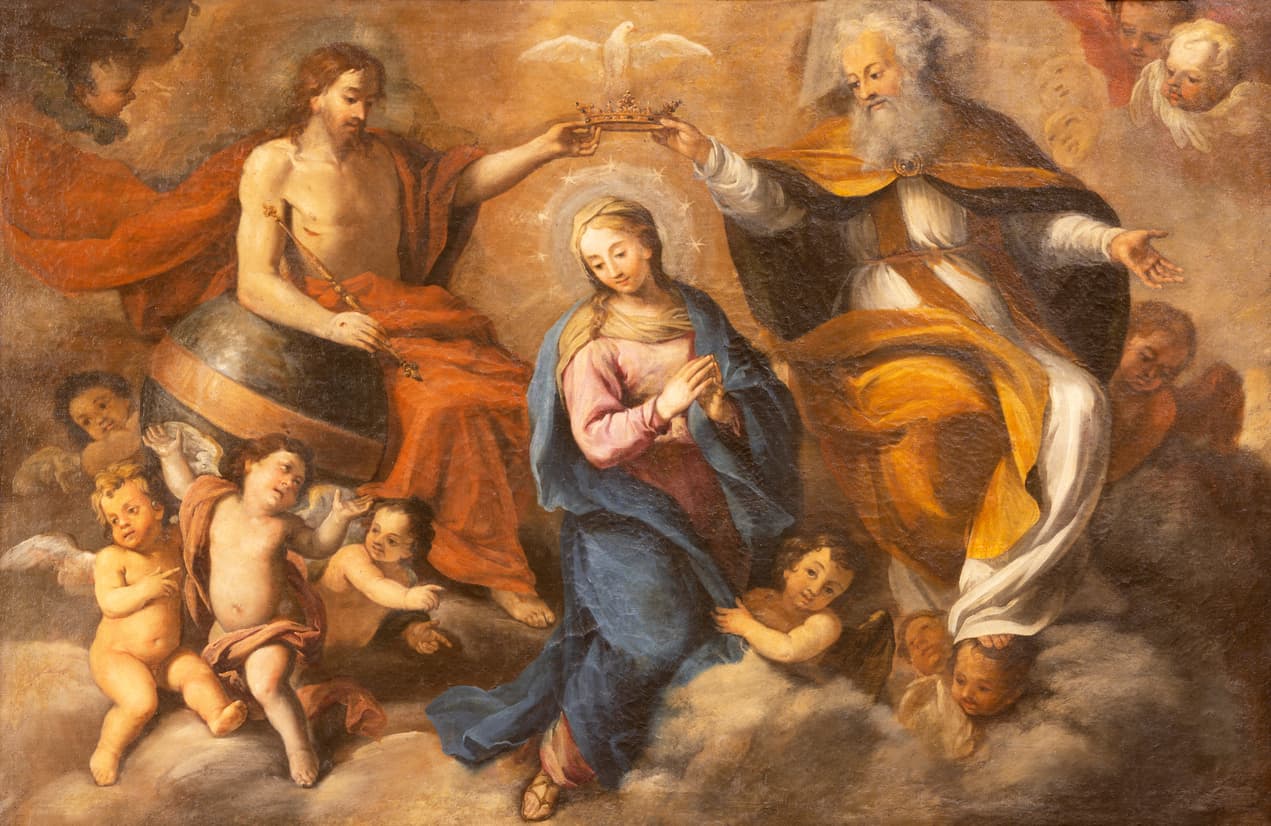
The Hail Holy Queen, known in Latin as the Salve Regina, is one of the most beloved and powerful prayers in Catholic tradition. For centuries, it has served as the closing prayer to the Rosary, and a beautiful chant that closes the day for consecrated religious around the world.
Whether you are finishing your Rosary or seeking comfort in a the "valley of tears," this prayer is a bedrock of Marian devotion.
Hail, holy Queen, Mother of mercy, our life, our sweetness and our hope. To thee do we cry, poor banished children of Eve. To thee do we send up our sighs, mourning and weeping in this valley of tears. Turn, then, most gracious advocate, thine eyes of mercy toward us, and after this, our exile, show unto us the blessed fruit of thy womb, Jesus. O clement, O loving, O sweet Virgin Mary.
V. Pray for us, O holy Mother of God.
R. That we may be made worthy of the promises of Christ.
Let us pray.
O God, whose only begotten Son, by His life, death, and resurrection, has purchased for us the rewards of eternal salvation. Grant, we beseech Thee, that while meditating on these mysteries of the most holy Rosary of the Blessed Virgin Mary, that we may both imitate what they contain and obtain what they promise, through Christ our Lord. Amen.
Note that this version features the conclusion for the Holy Rosary. The Hail Holy Queen has many concluding prayers depending on the context in which it is said. We go into this in more detail further on.
Sometimes, hearing the prayer spoken or chanted can help you learn it more quickly. Below, you can join us in praying the Hail Holy Queen as part of the Rosary.
The video below is set to begin exactly at the start of the prayer:
While the Hail Holy Queen traditionally ends with the triple exclamation ("O clement, O loving, O sweet Virgin Mary!"), it is almost always followed by a formal concluding prayer that changes depending on the liturgical setting.
When finishing the Rosary, the Hail Holy Queen is followed by the Versicle and Response, followed by the "Let us pray" (Oremus) collect. This specific prayer asks God that through meditation on the mysteries of the Rosary, we may "imitate what they contain and obtain what they promise."
It is important to note that if you are praying the Liturgy of the Hours (Divine Office), the prayer following the Hail Holy Queen (the Marian Antiphon) will differ. Depending on your tradition or the specific prayer book you use, you may encounter several different "collects" (concluding prayers) used to seal this devotion.
While many Catholics know these words by heart, we often overlook the specific "why" behind them. Traditionally, this prayer is the Marian Antiphon for Ordinary Time. In the Liturgy of the Hours—the official daily prayer of the Church—it is the last prayer spoken or sung before sleep.
In the context of the Rosary, the Hail Holy Queen acts as a bridge. After we have spent twenty minutes meditating on the life, death, and resurrection of Jesus Christ, we turn to Mary to ask her to "turn her eyes of mercy toward us" as we return to the struggles of our daily lives.
For those who appreciate the heritage of the Church, the Latin version of this prayer is very popular in sacred music. The Gregorian chant melody for the Salve Regina is one of the most recognizable in the world.
Salve, Regina, mater misericordiae;
vita, dulcedo et spes nostra, salve.
Ad te clamamus exsules filii Hevae.
Ad te suspiramus gementes et flentes
in hac lacrimarum valle.
Eia ergo, advocata nostra,
illos tuos misericordes oculos ad nos converte.
Et Iesum, benedictum fructum ventris tui,
nobis post hoc exsilium ostende.
O clemens, o pia, o dulcis Virgo Maria.
V. Ora pro nobis, sancta Dei Genitrix.
R. Ut digni efficamur promissionibus Christi.
Oremus.
Deus, cuius Unigenitus per vitam, mortem et resurrectionem suam nobis salutis aeternae praemia comparavit: concede, quaesumus; ut, haec mysteria sacratissimo beatae Mariae Virginis Rosario recolentes. et imitemur quod continent, et quod promittunt, assequamur. Per eundem Christum Dominum nostrum. Amen.
Note that this version features the conclusion for the Holy Rosary. The Hail Holy Queen has many concluding prayers depending on the context in which it is said.
The origins of the Hail Holy Queen date back to the 11th century. It is traditionally attributed to Blessed Hermann Contractus (Hermann the Cripple), a monk who suffered from a paralytic disease and a cleft palate. Despite his physical suffering, his spiritual joy was so great that he composed what would become the most famous Marian hymn in history.
Legend also tells us that St. Bernard of Clairvaux, in a burst of devotion while at the Cathedral of Speyer, added the final famous exclamations: "O clement, O loving, O sweet Virgin Mary!"
It serves as a final petition, asking Mary to take the meditations we have just completed and present them to her Son. It "seals" the Rosary with a plea for her perpetual intercession.
The prayer is a synthesis of biblical themes: the "Queen Mother" (1 Kings 2:19), the "Mother of Mercy" (foreshadowed in the Magnificat), and the "New Eve" who helps her children return to God.
It is simply the Latin for "Hail, Queen." It is the opening salutation of the prayer.
While common at the end of the Rosary, it is an excellent prayer for times of deep anxiety, grief, or when you feel "banished" from peace.
No Subscriptions, NoPaywall, 100% Free!
Experience the richness of our Catholic Faith with the free Covenant Network app, now available on your iPhone or Android.


No Subscriptions, NoPaywall, 100% Free!
Experience the richness of our Catholic Faith with the free Covenant Network app, now available on your iPhone or Android.


An initiative of Covenant Network
A new app for daily prayer and the interior life, coming to iOS.