What Is Eucharistic Adoration?
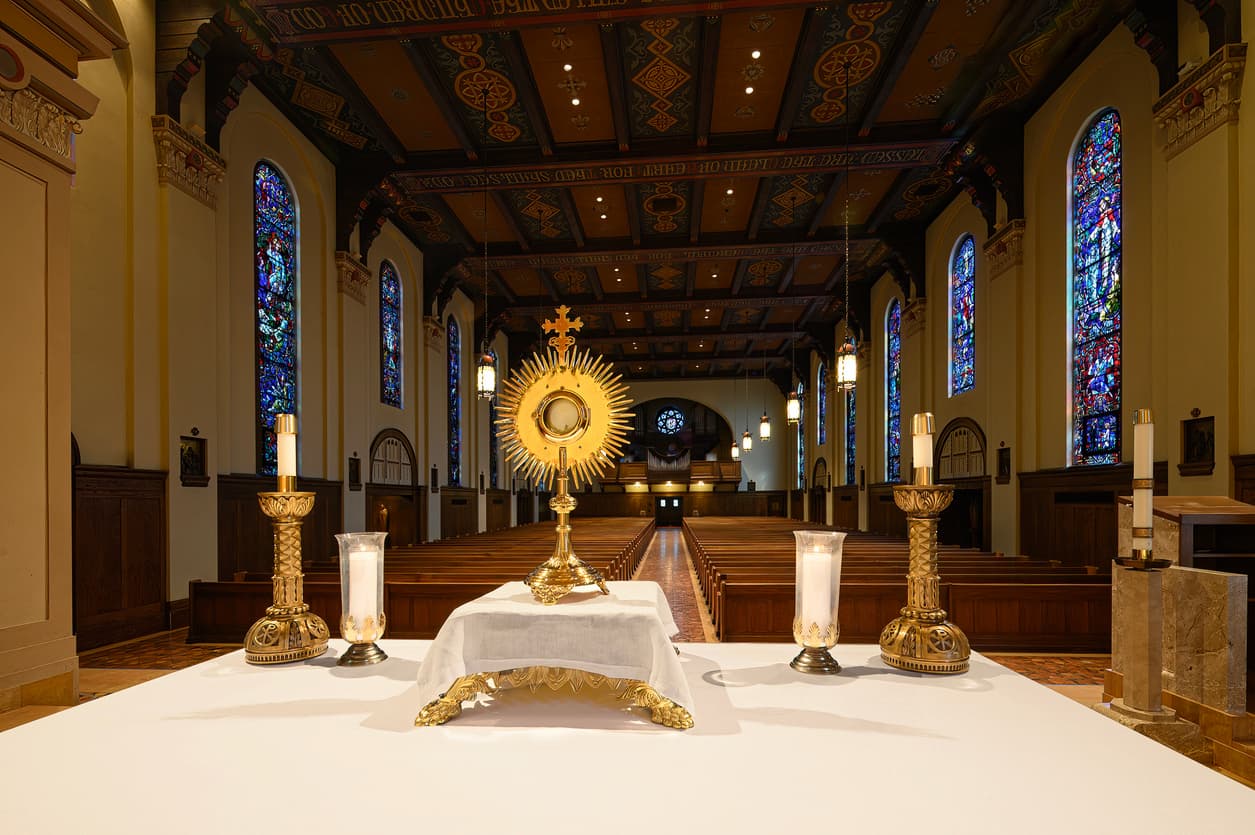
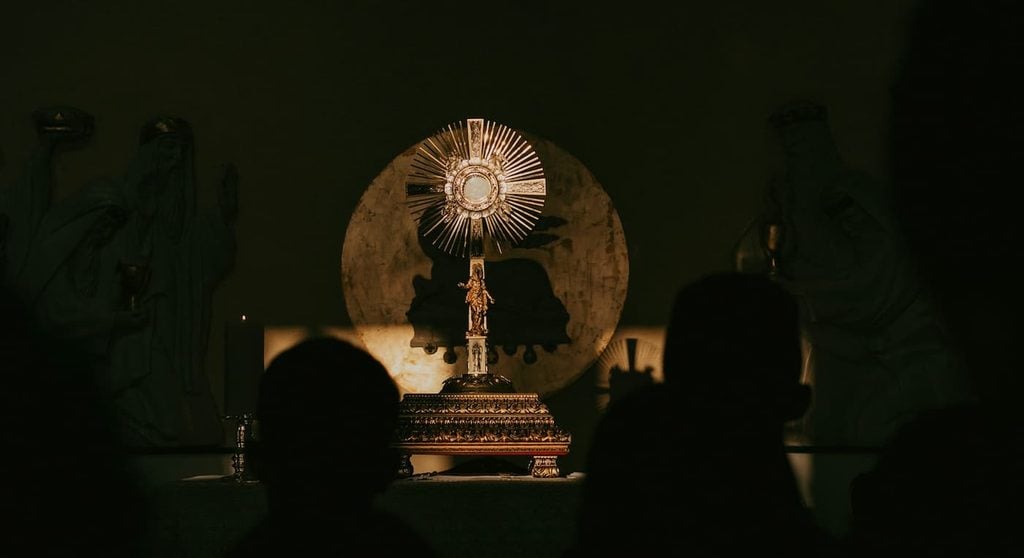
Eucharistic Adoration is the Catholic practice of praying before Jesus Christ, truly present in the Blessed Sacrament, outside of Mass, either before the tabernacle or before the consecrated Host exposed in a monstrance.
As Catholics, we believe the consecrated Host is the Body, Blood, Soul, and Divinity of Jesus Christ, truly and substantially present. Adoration grows out of the Mass: the same Lord we receive in Holy Communion remains with us in every tabernacle, and adoration is our response of love, gratitude, and worship. It is time set apart to pray, listen, and simply be with Him.
How to Do Eucharistic Adoration in 5 Steps
- Find a time and place. Check your parish schedule or an adoration chapel near you (see below).
- Enter quietly and genuflect toward the Blessed Sacrament, then find a seat.
- Pray. Talk to Jesus in your own words, pray the Rosary, read Scripture, or sit in silence.
- Stay as long as you can. A full holy hour is the tradition; 15 minutes is a fine start.
- Thank Him and genuflect again before you leave.
Everything below expands on these steps.
Adoration Before the Tabernacle vs. Exposition
There are two common ways to make adoration, and both are true adoration of the same Lord.
| Before the tabernacle | Exposition of the Blessed Sacrament | |
| Where Jesus is | Reserved inside the tabernacle, usually marked by a burning sanctuary lamp | The consecrated Host is placed in a monstrance on the altar, visible to all |
| When it’s available | Any time the church or chapel is open | At scheduled times, or around the clock in perpetual adoration chapels |
| Often called | A visit to the Blessed Sacrament | Adoration, exposition, or a holy hour |
| Closing | Whenever you leave | Often ends with Benediction, a blessing given with the Blessed Sacrament by a priest or deacon, though not always |
You don’t have to wait for exposition to make adoration. Stopping into any Catholic church to pray before the tabernacle is a visit with the same Jesus. To learn more about the rite itself, see our guide to Exposition of the Blessed Sacrament.
Why Catholics Adore the Eucharist
We adore the Eucharist because it is Jesus. At the Last Supper He said plainly, “This is my body” (Matthew 26:26), and in the Bread of Life discourse He insisted that His flesh is real food (John 6:53-56). The Church has always taken Him at His word.
The Catechism teaches that because Christ Himself is present in the sacrament of the altar, He is to be honored with the worship of adoration, and it calls visiting the Blessed Sacrament an expression of gratitude, love, and duty toward Our Lord (CCC 1378, 1418).
Adoration outside Mass developed gradually. According to tradition, the practice of exposing the Host for the faithful to see and adore spread in the Middle Ages, especially after the Feast of Corpus Christi was extended to the whole Church in the 13th century. Later devotions such as the Forty Hours and perpetual adoration grew from the same love for the Real Presence.
Adoration also changes us. In the silence before the Blessed Sacrament, we bring Him our burdens, receive His peace, and slowly learn to imitate His humility, patience, and love. Many find it the natural setting for mental prayer. St. Alphonsus Liguori encouraged the faithful with this promise:
“Be assured that the time you spend with devotion before this Divine Sacrament will be the most profitable to you in life and the source of your greatest consolation in death and in eternity.” (Visits to the Blessed Sacrament and the Blessed Virgin Mary)
St. John Bosco saw adoration as spiritual armor:
“My dear ones, the visit to the Blessed Sacrament is an extremely necessary way to conquer the devil. Therefore, go often to visit Jesus, and the devil will not come out victorious against you.” (quoted in Fr. Stefano Manelli, Jesus, Our Eucharistic Love)
The Church also attaches a plenary indulgence to adoration. The faithful who adore the Blessed Sacrament for at least half an hour may gain a plenary indulgence under the usual conditions: sacramental confession, Holy Communion, prayer for the Holy Father’s intentions, and detachment from all sin. A shorter visit carries a partial indulgence.
For more on the Real Presence, read Understanding Devotion to the Eucharist and Jesus Is Waiting for Us in the Holy Eucharist.
How to Find Eucharistic Adoration Near You
The quickest way to find adoration is to start with your own parish, then widen the search. Most Catholic parishes offer adoration at least weekly, and many have a dedicated chapel.
- Check your parish bulletin or website. Adoration times are usually listed alongside Mass and confession times. If you don’t see them, call the parish office.
- Search the Real Presence adoration directory. The Real Presence Eucharistic Education and Adoration Association keeps a state-by-state directory of U.S. adoration sites, searchable by city, including a consolidated list of perpetual adoration chapels.
- Use a parish-finder site. Many listings on Catholic Mass Times include each church’s adoration schedule along with Mass and confession times.
- Check your diocese’s website. Many dioceses list perpetual and extended adoration chapels in one place.
- Search Google Maps. Try “adoration chapel near me” or “perpetual adoration [your city].” Always confirm hours with the parish, since online listings can be out of date.
Many parishes also schedule adoration on First Fridays and First Saturdays, so those are good days to look. When you find a chapel, call ahead about entry codes, sign-in, and hours, especially for overnight visits. And remember: even when no exposition is scheduled, any Catholic church that is open has Jesus present in the tabernacle.
Before You Go: Practical Tips for Your First Visit
Call or check your parish website first. Many adoration chapels have security codes, sign-in sheets, or limited hours. Some parishes will walk you through the process on your first visit. It’s also worth asking about accessibility and parking. Knowing your way around ahead of time sets your mind at ease so you can focus on prayer.
Pray before you arrive. A short prayer in the car or on the walk in, asking God to guide your time with Him, helps you arrive recollected rather than rushed.
What to bring. You don’t need anything to make adoration. Still, many people keep a small chapel bag with a few helpful items:
- A rosary
- A Bible or prayer book
- A journal and pen
- Headphones or earbuds, if you plan to use a prayer app
Many chapels also keep a small library of prayer books and devotional reading. Leave food and drinks at home or in the car.
What to Do During Eucharistic Adoration
There is no required script. Do whatever helps you stay present to Jesus. Here are the most common ways to pray:
- Talk to Him. Speak to Jesus in your own words, as you would to a close friend. Tell Him what’s on your heart, including worries, gratitude, and the people you love.
- Pray traditional prayers. The Rosary, the Divine Mercy Chaplet, a litany, or classic Eucharistic prayers like the Anima Christi and the Tantum Ergo. See our list of Eucharistic adoration prayers and the Divine Praises.
- Read Scripture. Slowly read a Gospel passage, such as John 6 or the Passion narrative, and let a word or phrase stay with you.
- Write in a prayer journal. Writing helps keep your mind focused and lets you remember the resolutions and insights that come during prayer.
- Read a spiritual book. A short passage from a saint or spiritual classic can open your heart to prayer.
- Sit in silence. Sometimes the deepest prayer is simply looking at Him and letting Him look at you. Silence can be hard at first in our noisy lives, but it is often where we receive His peace.
If your mind wanders, don’t be discouraged. Gently return your attention to Jesus each time. That small act of returning is itself a prayer.
How to Make a Holy Hour
A holy hour is one hour spent in prayer before the Blessed Sacrament. The practice traces to Our Lord’s words to His sleeping apostles in Gethsemane:
“What? Could you not watch one hour with me?” (Matthew 26:40, Douay-Rheims)
An hour can feel long at first. A simple structure helps. Many people use the ACTS pattern, giving about 15 minutes to each part:
- Adoration (15 minutes). Praise God for who He is. Pray the Divine Praises or the Gloria, or simply tell Jesus you love Him.
- Contrition (15 minutes). Examine your conscience and ask His forgiveness. An Act of Contrition is a good way to begin.
- Thanksgiving (15 minutes). Thank Him for specific blessings, big and small.
- Supplication (15 minutes). Bring Him your needs and the needs of others. Then rest in silence and listen.
If an hour isn’t possible, start smaller. Fifteen minutes of sincere prayer is a beautiful offering, and many people work up to a full holy hour over time. When you finish, thank Jesus for the time with Him before you leave.
Take prayers with you. Our collection of 15 Eucharistic Adoration Prayers is organized by intention, from praise to healing, so you can bring it on your phone or print it for your chapel bag.
Eucharistic Adoration Etiquette
Arriving and Leaving
Entering the chapel. If there is a holy water font at the door, bless yourself with the Sign of the Cross. Then genuflect toward the Blessed Sacrament as a sign of adoration.
One knee or two? The Church’s current norm is a single genuflection on one knee, whether Jesus is reserved in the tabernacle or exposed in the monstrance (Holy Communion and Worship of the Eucharist Outside Mass, 1973, n. 84). Before the Second Vatican Council, a double genuflection on both knees before the exposed Sacrament was the custom, and many still make it out of devotion. Either is fitting. If you can’t genuflect, a profound bow is a good alternative.
Leaving. Before you go, genuflect again toward the Blessed Sacrament. In some chapels you sign out or, during scheduled hours, wait for the next adorer to arrive.
During Your Visit
Find a seat and settle in. Kneel, sit, or stand as you’re able. There is no required posture.
Keep silence and give others space. Adoration chapels are places of quiet prayer, and many people come for a treasured hour in a busy week. If others are present, pray silently; if you’re alone, it’s fine to pray or sing aloud. It’s not rude to walk past someone you know without a greeting. A small smile or nod is plenty, and if you need to talk, step outside and away from the door.
Phones. It’s fine to bring your phone, especially for prayer apps, but silence the ringer, notifications, and alarms. Use headphones for audio, such as the free Covenant Network app. If you need to take a call or text, step outside.
Emotions are welcome. Adoration is an intimate encounter with God. If you or someone near you is moved to tears, that’s a normal part of prayer. No one will mind, and others will often quietly pray for you.
Bringing Children to Adoration
The noisiest blessings you can bring to adoration are your children. Our Lord Himself welcomed them:
“Suffer the little children to come unto me, and forbid them not; for of such is the kingdom of God.” (Mark 10:14, Douay-Rheims)
Check with your parish about any guidelines for children first. At most parishes, you’ll find patient adorers who will give you space and quietly admire your faithful parenting. A few tips help:
- Start short. Begin with five or ten minutes and build up as your children learn to enjoy the silence.
- Pack quiet items. Soft toys that won’t make noise, picture books, coloring pages, and a child-friendly rosary.
- Give them something to do. Invite older children to tell Jesus one thing they’re thankful for, or to pray one decade of the Rosary with you.
- Step out when needed. If a little one gets restless, a short break outside is no failure. Simply bringing them is a gift.
What Is Perpetual Eucharistic Adoration?
Perpetual adoration means the Blessed Sacrament is exposed for adoration 24 hours a day, seven days a week. Parishes need the local bishop’s permission to establish it.
Because the exposed Blessed Sacrament should never be left unattended, perpetual adoration chapels rely on committed adorers. Each volunteer signs up for the same hour every week, and substitutes cover when someone can’t come. Some chapels offer exposition only during the day and repose the Blessed Sacrament in the tabernacle overnight, which is called extended rather than perpetual adoration.
Perpetual adoration is a gift for anyone whose schedule makes it hard to pray at set times. You can stop in early in the morning, on a lunch break, or in the middle of the night. If your parish has a perpetual adoration chapel, consider signing up for a weekly hour. Committed adorers are what keep the chapel open.
Frequently Asked Questions
What do you do during Eucharistic Adoration?
Pray in whatever way helps you stay present to Jesus: talk to Him in your own words, pray the Rosary or other traditional prayers, read Scripture or a spiritual book, write in a journal, or simply sit in silence. There is no required script.
Do I have to be Catholic to go to Eucharistic Adoration?
No. Anyone may come and pray quietly in an adoration chapel. Many people who are exploring the Catholic faith find adoration a peaceful first step.
How long should I stay in adoration?
There is no minimum or maximum. A holy hour is the traditional practice, but even 10 or 15 minutes of sincere prayer is a beautiful offering. Staying at least half an hour also allows you to gain a plenary indulgence under the usual conditions.
What is the difference between Adoration and Benediction?
Adoration is the act of worshipping Jesus present in the Eucharist, and it can last as long as you like. Benediction is a short liturgical service, usually at the end of exposition, in which a priest or deacon blesses the people with the Blessed Sacrament.
Do I need to be in a state of grace to go to adoration?
No. Unlike receiving Holy Communion, adoration doesn’t require you to be free of mortal sin. In fact, adoration is a wonderful place to prepare for confession.
Can I use my phone during adoration?
Yes, for prayer apps, Scripture, or spiritual reading. Silence all notifications and use headphones for audio.
What should I wear to adoration?
Dress modestly, as you would for Mass. There’s no formal dress code, and no one will turn you away for coming straight from work.
Begin Today
You don’t need to know every prayer or custom to begin. Jesus is waiting for you in the Blessed Sacrament, and He welcomes you just as you are. Find a chapel near you, bring an open heart, and give Him your time. For prayers to take with you, see our 15 Eucharistic Adoration Prayers, and explore more resources on the Holy Eucharist.