What Is Exposition of the Blessed Sacrament?
Exposition of the Blessed Sacrament is the rite in which a priest or deacon places the consecrated Host in a monstrance on the altar so the faithful can see and adore Jesus Christ, truly present in the Eucharist. It is one form of Eucharistic Adoration, which also includes praying before the tabernacle when the Host is not exposed.
Exposition usually opens with a hymn and incense, continues with a period of prayer that may last an hour or run around the clock, and often closes with Benediction. This guide explains the rite itself: its history, its theological basis, how the ceremony unfolds, and the norms that govern it.
During Exposition the consecrated Host is displayed for adoration in a monstrance or ostensorium, often accompanied by hymns, prayers, Scripture reading, and silent reflection. It typically takes place in a church or chapel, where the Blessed Sacrament is placed on the altar surrounded by candles and flowers. Individuals may offer their own prayers, sit in silent contemplation, or join in formal devotions such as the Rosary or the Divine Mercy Chaplet. Throughout, the faithful express their love for Christ in the Eucharist in an atmosphere of solemnity and reverence.
The Historical Background
This revered practice has its roots in the Middle Ages, around the 13th century. It evolved from the faithful’s desire to see the consecrated Host and to adore Christ, truly present in the Eucharist. Over time it became a central element of Eucharistic devotion, culminating in the institution of the Feast of Corpus Christi and the Eucharistic processions associated with it.
The Theological Basis
The theological foundation of Exposition lies in the Church’s belief in the Real Presence: that Christ is truly present, Body, Blood, Soul, and Divinity, in the Eucharist. This belief gives rise to Eucharistic Adoration, and from it to the Exposition of the Blessed Sacrament. To go deeper, read Understanding Devotion to the Eucharist.
The Scriptural Roots of the Eucharist
The Bread of Life discourse and the Last Supper establish the foundation for adoring Christ in the Eucharist. These events in the Gospels reveal the Real Presence of Jesus and invite believers to adore Him in this form.
“Then Jesus said to them: Amen, amen I say unto you: Except you eat the flesh of the Son of man, and drink his blood, you shall not have life in you. He that eateth my flesh, and drinketh my blood, hath everlasting life: and I will raise him up in the last day.” (John 6:54-55, Douay-Rheims)
This teaching caused confusion and even scandal among His followers. Yet Jesus did not back down or soften His words. He reaffirmed them, insisting on the necessity of partaking in His Body and Blood.
The Last Supper, described in the synoptic Gospels (Matthew 26:26-29, Mark 14:22-25, Luke 22:14-20), is the event in which Jesus instituted the Holy Eucharist. During this final Passover meal He took bread, blessed it, broke it, and gave it to His disciples.
“And whilst they were at supper, Jesus took bread, and blessed, and broke: and gave to his disciples, and said: Take ye, and eat. This is my body. And taking the chalice, he gave thanks, and gave to them, saying: Drink ye all of this. For this is my blood of the new testament, which shall be shed for many unto remission of sins.” (Matthew 26:26-28, Douay-Rheims)
Together, the Bread of Life discourse and the Last Supper reveal the reality of Christ’s presence in the Eucharist, His Body and Blood under the appearance of bread and wine. Adoration acknowledges and honors that presence.
The Ritual of the Exposition
Exposition is a solemn ceremony regulated by specific liturgical norms. It extends the adoration of the Blessed Sacrament that occurs in every Mass, deepening the faithful’s hunger for communion with Christ and with the rest of the Church.
The Procedure
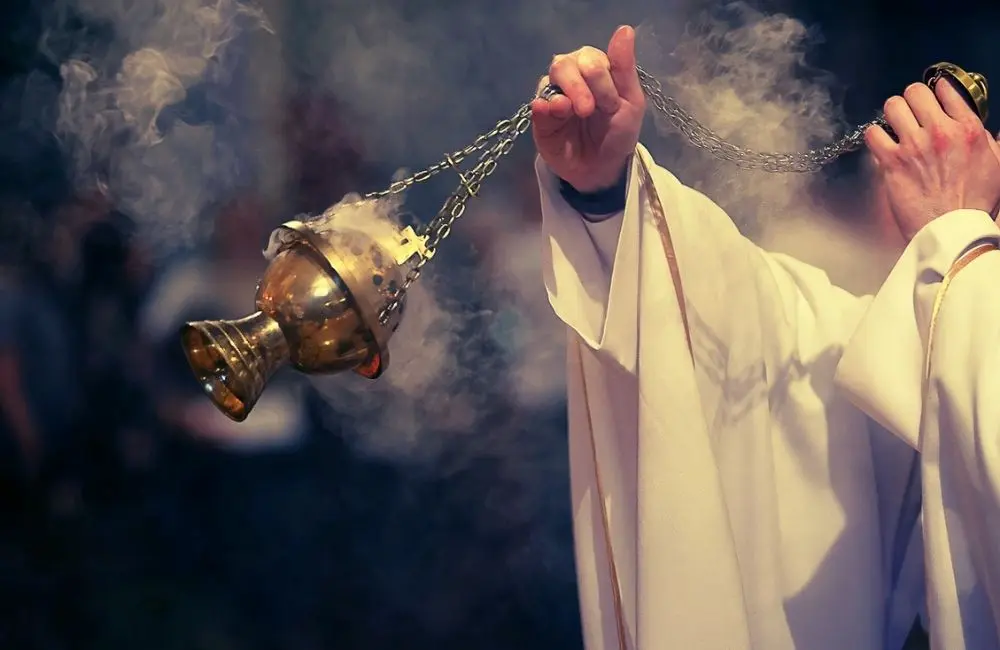
The priest or deacon places the Blessed Sacrament in the monstrance on the altar. A hymn of praise, often the O Salutaris Hostia, is sung as the Blessed Sacrament is incensed. The faithful then pray in silence, fostering a deeper spiritual communion with the Lord. The Church asks that a genuflection on one knee be made before the Blessed Sacrament, whether reserved in the tabernacle or exposed for adoration.
The Benediction
Exposition concludes with Benediction, a blessing given with the Blessed Sacrament. The Tantum Ergo is sung and the Host is incensed again. The priest or deacon, wearing a humeral veil, raises the monstrance and makes the Sign of the Cross over the people in silence. Benediction is a profound moment of grace, as the faithful receive the blessing from Christ Himself. Afterward the congregation prays the Divine Praises together before the Blessed Sacrament is reposed in the tabernacle.
Exposition, Adoration, and Benediction: What’s the Difference?
The three terms are often used together, so it helps to keep them straight. Adoration is the act of worshipping Jesus in the Eucharist, whether He is exposed or reserved in the tabernacle. Exposition is the rite of displaying the Host in the monstrance for adoration. Benediction is the blessing with the Blessed Sacrament that typically closes a period of exposition.
Eucharistic Processions
Another form of Eucharistic devotion is the Eucharistic procession, most commonly seen on the Feast of Corpus Christi. The Blessed Sacrament is carried in a monstrance through the church or the streets, often with hymns, candles, and a canopy. This public witness is a powerful expression of devotion to the Real Presence.
Perpetual Exposition of the Blessed Sacrament
Perpetual Exposition refers to the continuous exposition of the Blessed Sacrament, with individuals or groups taking turns in adoration so that the Host is never left unattended. It requires the explicit permission of the local bishop and must follow specific liturgical norms to ensure proper reverence.
The Significance of Perpetual Exposition
Perpetual Exposition reflects the depth of the Church’s love for Christ in the Eucharist. It is a testament to the faithful’s desire to spend time in the presence of the Lord at every hour of the day and night. For the practical side, including how adorer schedules work and how to find a perpetual adoration chapel, see What Is Perpetual Eucharistic Adoration?
The Role of the Local Bishop
The local bishop holds authority over the Exposition of the Blessed Sacrament in his diocese. He ensures that the liturgical norms are followed and that the right sense of reverence and devotion is maintained.
Making the Most of Exposition
Exposition is an invitation, not a ceremony to watch from a distance. Whether you stay for ten minutes or a full holy hour, the time before the monstrance is time with Jesus Himself. If you’re new to adoration, our beginner’s guide to Eucharistic Adoration covers what to do during your visit, simple etiquette, and how to find exposition near you. For prayers to bring with you, see our 15 Eucharistic Adoration Prayers.
Conclusion
The Exposition of the Blessed Sacrament is a profound and beautiful expression of the Church’s love and reverence for the Eucharist. It invites us into a deeper relationship with Christ, fostering a spirit of prayer, adoration, and contemplation. As we kneel before the Real Presence of Jesus, we are invited to surrender ourselves to His love, to be nourished by His grace, and to be transformed by His presence. Explore more on the Holy Eucharist, the source and summit of our Catholic faith.