Quick Facts
- Date: 1830
- Location: Rue du Bac, Paris, France
- Seer: St. Catherine Labouré
- Approval status: Vatican-approved
- Associated shrine: The Chapel of Our Lady of the Miraculous Medal, Rue du Bac, Paris, France
- Feast day: November 27
Prefer to Listen? (24 mins)
In 1830, in Paris, France, a young nun named Catherine Labouré of the Daughters of Charity received two apparitions from the Blessed Mother. In the second appearance, now also referred to as Our Lady of Grace, she asked her children to pray for the many graces which were not being sought, and she gave Catherine instructions to cast a medal. The medal was distributed during a cholera outbreak by obedient nuns who knew nothing of the apparitions or of Catherine. It was named the Medal of the Immaculate Conception, but it worked so many miracles of healing and conversion that it became known as the Miraculous Medal.
The Historical Context
The Rebellious First Daughter
In the 1500s, France, Eldest Daughter of the Church, entered a tumultuous period. The Reformation in France was followed by more than two centuries of revolution, martyrdom, atheism, famine, and plague. During this time, many left the Church. Across France, churches, convents, and monasteries were looted and burned while religious faced varying degrees of persecution, including martyrdom. While some Protestant groups like the Huguenots left France, many remained but did not stay Protestant. Instead, they left Christianity entirely. Among the poor, crime and despondency grew, while among the elite the Enlightenment blossomed into full-scale revolutions and dictatorships. Various factions fought for control of the country and for greater control over Europe.
Relics on an Epic Journey
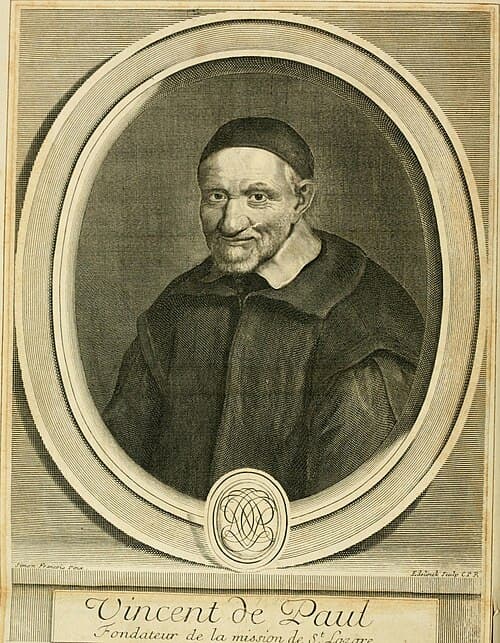
Amid the rebellion against the Church in the 1500s and 1600s, God raised up great saints of the Counter-Reformation, including St. Vincent de Paul. St. Vincent, known as the Father of the Poor, founded the Vincentians and the Daughters of Charity to care for the poor, the sick, and the orphaned. He died September 27, 1660, in Paris. He was canonized in 1737. During the process, his heart was found incorrupt.
In the 1700s, during the tumult of the French Revolution and its periods of persecution, St. Vincent de Paul’s relics (his incorrupt heart, bones, bits of his hair, and an assortment of personal effects like clothes and books) went through several harrowing transports and an epic journey of their own. They ended up hidden at the Mother House of the Daughters of Charity. Despite the bloodshed, blasphemy, and plundering, when the monarchy retook the throne in 1815 and expanded religious freedom, Catholics were still a majority.
Relics in Grand Procession
In 1827, when the unrest calmed once more, a chapel was built at Rue de Sèvres by the Congregation of the Mission (Lazarists) to display St. Vincent de Paul’s relics once again. On April 25, 1830, a formal translation—a grand procession of thousands of people—paraded through the streets of Paris from the Mother House on Rue du Bac to the Chapel of the Lazarists, a grand spectacle celebrating the saint’s life and demonstrating the continuing presence of the Church despite persecution.¹
The Story of Our Lady of the Miraculous Medal
St. Vincent de Paul Visits Catherine Labouré in a Dream
Amid the political turmoil, Catherine Labouré was born to yeoman farmers in 1806. Her mother died when she was nine, and young Catherine asked the Blessed Mother to be her mother. Ten years later, in a dream, an elderly priest told her God wanted her to care for the sick. Much later, she would see a picture of the priest and realize it was St. Vincent de Paul.
Catherine’s Determination to Enter Religious Life
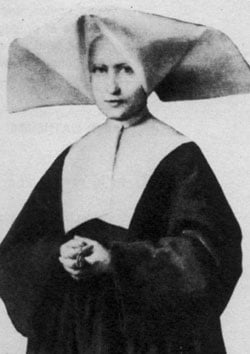
When Catherine told her father she wanted to enter religious life, he angrily sent her to live with her brother in Paris, hoping she would marry in the city. Instead, she grew disgusted by Paris’s debauchery. Next, she lived with her aunt but disliked the superficiality of her elite lifestyle. Finally, her father allowed her to join the Daughters of Charity in Châtillon in January of 1830. Three months later, her order sent her to Paris, to the house on Rue du Bac.
The First Visions
She arrived in Paris as the order prepared to move the relics of St. Vincent de Paul. Catherine marched in the grand procession, joyously celebrating the priest who had given her the calling to religious life. Then, for the next few months, Catherine began to have mystical visions of St. Vincent de Paul and of Christ as King.
Being brand new to the house, Catherine was terrified to tell anyone of her visions. She knew how crazy she sounded, but eventually she told her confessor, Fr. Aladel, whom she had spoken to only once before this admission. He immediately told her to put all the nonsense out of her mind. From that point on, she trembled in fear when she spoke with him. Fr. Joseph Dirvin wrote, “Confusing as it was, it was good for her, for it removed any least danger that she might begin to cherish her own self-importance, and it purified her soul as trials are meant to do.”²
Catherine Dares to Ask for a Great Grace
On July 18, 1830, the eve of St. Vincent de Paul’s feast day, the reverend mother brought out a relic—clothing once worn by St. Vincent—cut it up, and distributed the bits to each of the sisters so each could have a relic to carry. Catherine took hers back to her room, prayed a long while to this great saint, then tore the relic in two and swallowed one of the halves. She prayed for a miracle: to be able to see her Blessed Mother. She went to sleep with the prayer in her heart.
The Blessed Mother Visits Her Daughter
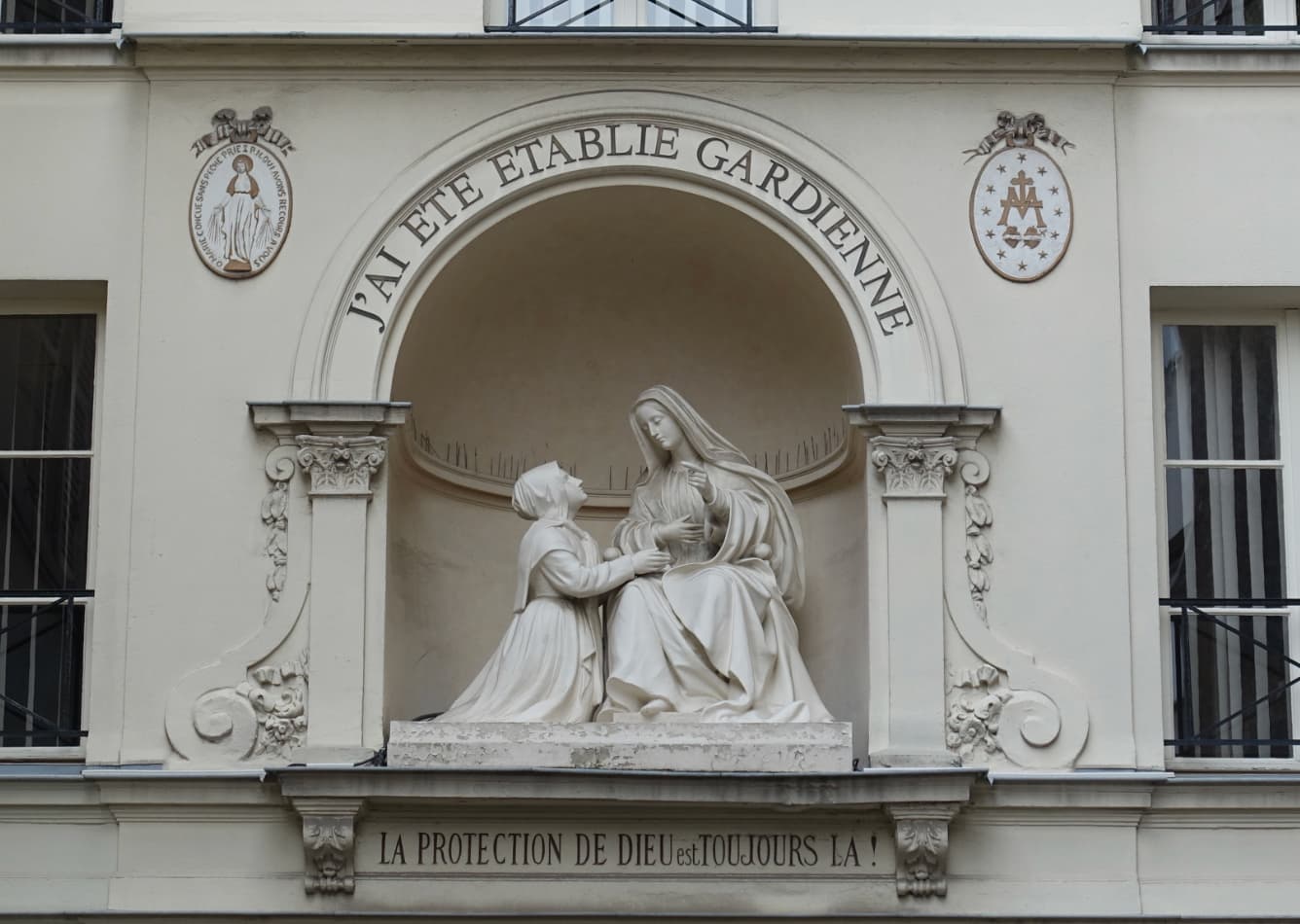
At 11:30 p.m., Catherine was awakened in the night by a child-sized angel in dazzling light. “Come to the chapel. The Blessed Virgin is waiting for you.”³ The angel led her to where the Blessed Mother waited in a chair by the altar. Catherine clasped Mary’s hands and knelt at her feet. For the next few hours they conversed with the intimacy of mother and daughter sharing their hearts with one another. Mary spoke to Catherine of her future and of how she would know the will of God for her life. These hours of conversation were private; the specifics remain unknown to the world.
Prophecies of Dark Days to Come
Mary also had a public task for Catherine, and of that mission she said Catherine would need to tell her confessor everything. “The times are very evil. Sorrows will come on France; the throne will be overturned. The whole world will be upset by miseries of every kind.”⁴ Mary’s remedy for these times of great evil was the tried and true plan of the Gospel: “Come to the foot of the altar. There graces will be shed upon all, great and little, who ask for them.”⁵
During the remainder of the conversation, Mary shared particulars of what would happen over the next forty years and allowed Catherine time to express her emotions and ask questions. The prophecies were not given to stop events from happening, but simply to prove to Catherine’s confessor that Mary was really speaking. Among the prophecies given were:
- King Charles X would lose the crown.
- The Archbishop of Paris would be attacked.
- Fr. Aladel would have to hide a bishop.
- During the coming miseries and bloodshed, the Vincentian Fathers and the Daughters of Charity would receive special protection, but other religious communities would not be spared.
When the conversation with Mary ended, Catherine knew she had received the grace needed to face what lay ahead. “The moment will come when the danger will be enormous; it will seem that all is lost; I will be with you; have confidence.”⁶ Catherine took the message deep into her heart.
Fr. Aladel Reconsiders
As before, Fr. Aladel told Catherine to put the nonsense out of her mind. But only a week later, the first of the prophecies began to unfold. King Charles X tried to suspend the constitution. Insurrection broke out on the streets of Paris once more. The Archbishop was attacked. Fr. Aladel was asked to welcome a bishop into hiding. Though he wondered if this sequestered little novice could have overheard the plans of revolutionaries and confused them for a vision, he did not doubt her sincerity. Now he had to reconsider her assertions.
Vision of Our Lady of Grace
On November 27, 1830, the Blessed Mother appeared to Catherine again. This time, Catherine was in the chapel at a group meditation at 5:30 p.m. when she heard the sound of rustling silk. She looked up and saw Mary framed by an oval, standing on the top half of a globe.⁷ Catherine, in her written account for the investigation, reported:
Her hands were raised about as high as her waist, and she held in a graceful attitude another globe (a figure of the universe). Her eyes were lifted up to Heaven, and her countenance was radiant as she offered the globe to Our Lord.
Suddenly, her fingers were filled with rings and most beautiful precious stones; the rays gleaming forth and reflected on all sides, enveloped her in such dazzling light that I could see neither her feet nor her robe. The stones were of different sizes, and the rays emanating from them were more or less brilliant in proportion to the size.
I could not express what I felt, nor what I learned, in these few moments.
Whilst occupied contemplating this vision, the Blessed Virgin cast her eyes upon me, and a voice said in the depths of my heart: “The globe that you see represents the entire world, and particularly France, and each person in particular.”⁸
Catherine was enraptured during this vision, caught up in the beauty of Our Lady. She explained:
I would not know how to express the beauty and brilliancy of these rays. And the Blessed Virgin added: “Behold the symbol of the graces I shed upon those who ask me for them,” thus making me understand how generous she is to all who implore her intercession… How many favors she grants to those who ask. At this moment I was not myself, I was in raptures!⁹
On the outside of the oval framing the Blessed Mother, a prayer appeared in golden letters:
O Mary! conceived without sin, pray for us who have recourse to thee!¹⁰
Mary Commissions a Medal
Mary then requested that Catherine have a medal made of this vision and its framing prayer, to be called the Medal of the Immaculate Conception. The vision then turned 180° to reveal what Mary wished presented on the reverse side of the medal. In Fr. Aladel’s book, The Miraculous Medal: Its Origin, History, Circulation, Results, he gives us the explanation recorded from his verbal testimony on February 16, 1836, as part of the formal investigation:
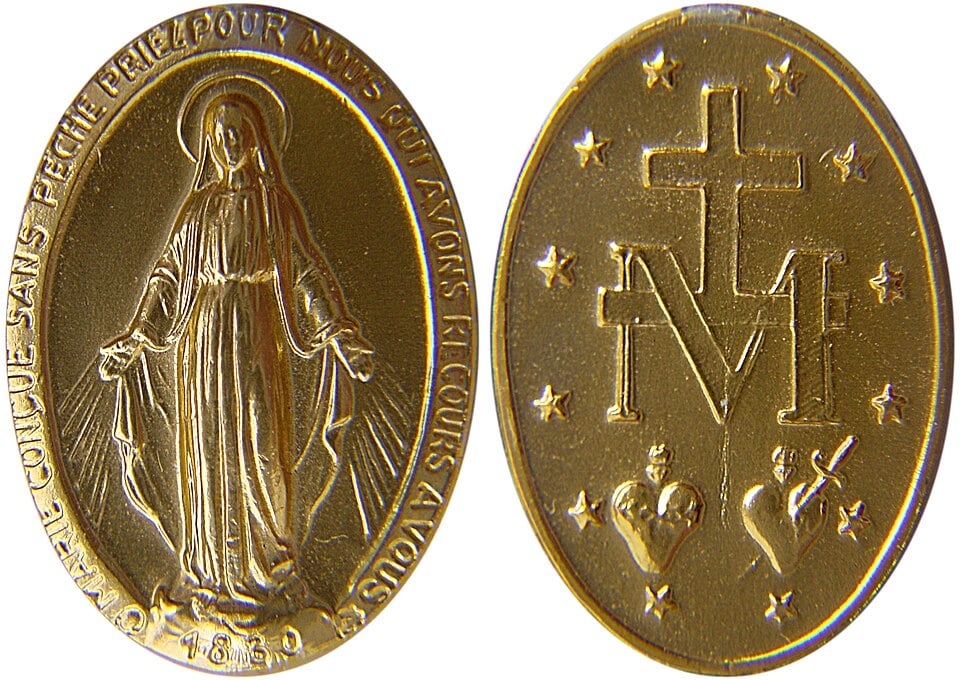
“The reverse of the picture bore the letter M surmounted by a cross, having a bar at its base, and beneath the monogram of Mary were the hearts of Jesus and Mary, the first surrounded with a crown of thorns, the other transpierced with a sword.”¹¹
Finally, Mary promised Catherine, “All who wear [the medal] will receive great graces; they should wear it around their neck. Graces will abound for those who wear it in confidence.”¹² Catherine did not doubt Our Lady, but she also knew her confessor would not easily cast the medal.
The Blessed Mother would repeat this vision a handful of times before Fr. Aladel would believe Catherine. Possibly it was during these visions that Catherine came to understand a few more details. Whatever the case, eventually the dragon would be portrayed under Mary’s feet on the globe, and the monogram on the reverse side would be framed with twelve stars. Fr. Aladel would also later write, “Other notes in Sister Catherine’s own handwriting complete the account…some of these precious stones did not emit rays, and when she expressed her astonishment at this, she was told that they were a figure of the graces we neglect to ask of Mary.”¹³ Each element of the design Our Lady revealed carries rich meaning, explained in full in our complete guide to the Miraculous Medal.
An Academic Priest Faces the Impossible
Before the medal could be cast, Catherine had a tough job ahead of her. She had to convince her confessor that Mary had actually made the request. Mary had warned her the first time she appeared, “You will be contradicted, but you will have the grace to bear it. Don’t be afraid.”¹⁴
Visibly trembling, Catherine took the matter to Fr. Aladel alone. Though they argued five times, with raised voices booming from the confessional, she never tried to go over his head to a superior. Nor did she ever tell her experiences to anyone else. She simply waited in obedience. At first, he dismissed her outright, but, according to Fr. Aladel, Mary presented this vision to Catherine at least three more times, possibly more, throughout the winter months.
Fr. Aladel was in the midst of a revolution, a plague, and general societal chaos. It seemed counterintuitive to begin the expensive process of having a medal commissioned and distributed when wearing religious identifiers could potentially mark you for death.
Catherine’s Character Convinces
As he wrestled with his options, Fr. Aladel was probably the most austere, academic-minded priest this could have happened to, the most unlikely to get excited about mysticism and visions. Yet here he held the outcome of the Blessed Mother’s wishes in his hands, and his decision hinged on a young novice he barely knew.
But Catherine’s personality was not one for hysteria. According to biographer Fr. Joseph Dirvin, C.M., her confessor considered her “basically good and pious,” but he also considered her “intellectually incapable of making up the Apparitions” and “totally unimaginative.”¹⁵ He had seen her interactions in her day-to-day life and realized she was not the type to go around inciting antics or telling tales to the other nuns. She was not talking about the apparition to the other nuns. She humbly looked out for others and did her work dutifully. Ultimately, he could not deny that her predictions were fulfilled one after another.
Late in his life, Fr. Aladel would reflect on her humility and write, “Is not the conclusion inspired by the spirit of St. Vincent, ‘I have been chosen, because being nothing, no one could doubt that such great things are the work of God.'”¹⁶
The Miraculous Medal
Without revealing Catherine’s identity, Fr. Aladel convinced the archbishop to make this medal, which was originally called the Medal of the Immaculate Conception. Distribution began in 1832 within the wards of cholera patients. Obedient nuns passed them out without asking where they came from or why.
Despite the odds, the popularity of the medal grew rapidly. Many who wore it experienced healing miracles and conversion. Eventually, the medal became known as the Miraculous Medal. According to an article on the Central Association of the Miraculous Medal website, “The demand for the Medals became so great that between 1832 and 1836, Vachette made more than two million of them. There were eleven other engravers in Paris producing Medals, as well.”¹⁷
Like the Rosary, the fruit of this apparition is tied to a devotion rather than a place. According to the Compendium of the Miraculous, “As many as a billion medals have since been made, bringing countless blessings and graces to the faithful.”¹⁸ While some companies make beautiful, expensive versions, most are simple medals made and distributed free of charge by convents and monasteries.
St. Catherine Humbly Works in Obscurity
Fr. Aladel ordered Catherine to write down her experiences on several occasions so that the Church would one day know what had happened. However, honoring his promise to her, Fr. Aladel kept her identity a secret during her lifetime.
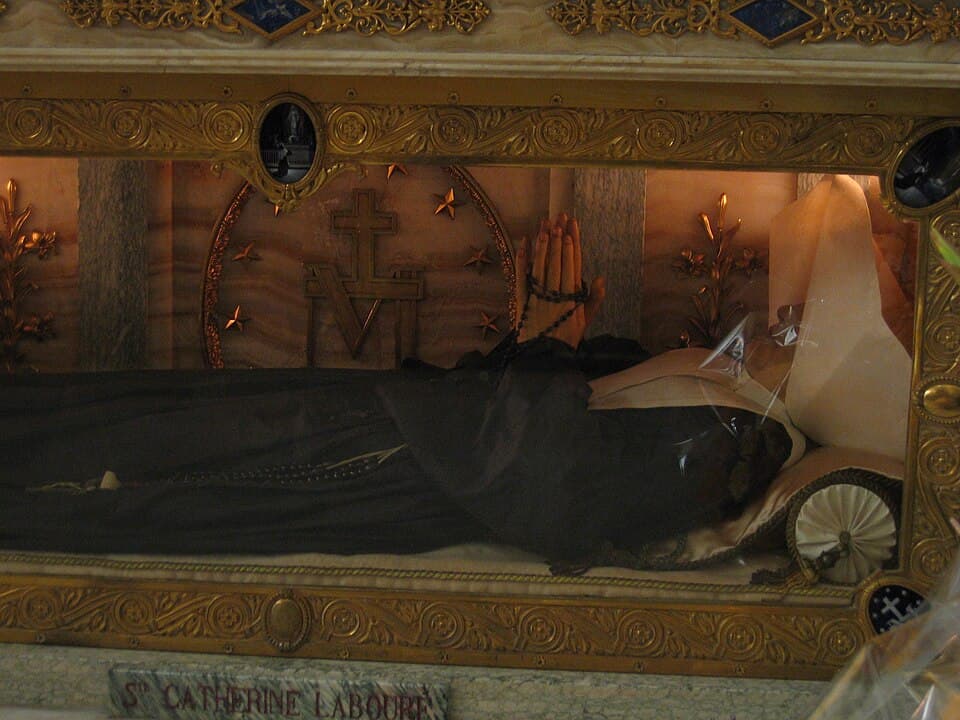
Catherine was transferred to a hospital, where she fulfilled St. Vincent’s prophecy by working with the sick. She remained there forty-five years. She died on December 31, 1876. Not even the sisters in her order knew what had transpired with the apparitions, but they readily testified to her holiness at her canonization. Fifty-seven years after her death, her body was found completely incorrupt, her eyes still blue. She was canonized July 27, 1947.
The Message and Call
During this time of great evil in France, the Marian apparition at Rue du Bac became a beacon in the dark to the persecuted Catholics who kept the faith. Mary called her children to a new level of trust. She reached out in simplicity to the lowly, downtrodden, and sick, called people back to the Cross and the Sacraments, and lavishly distributed graces on all who asked. She gave us a medal which we wear around our necks as a physical reminder of the Protoevangelium.
The Protoevangelium
As with many Marian apparitions, the vision of a Queen on a globe and twelve stars surrounding the symbols of Mary and Jesus harkens back to the Protoevangelium.
In Genesis 3:15, God gave us the first Protoevangelium promise:
I will put enmities between thee and the woman, and thy seed and her seed: she shall crush thy head, and thou shalt lie in wait for her heel.¹⁹
The Catechism of the Catholic Church (410–411) explains that after the fall, God did not abandon man but immediately heralded his coming victory over evil. This passage in Genesis is called the Protoevangelium, “the first announcement of the Messiah and Redeemer, of a battle between the serpent and the Woman, and of the final victory of a descendant of hers.” The Church sees in it the New Adam, Christ, whose obedience unto death on the Cross repairs the disobedience of Adam, and many Fathers and Doctors of the Church have seen in the Woman Mary, the New Eve, who alone was preserved from every stain of sin by Christ’s victory.
In Ephesians 6:12, St. Paul wrote:
For our wrestling is not against flesh and blood; but against principalities and powers, against the rulers of the world of this darkness, against the spirits of wickedness in the high places.²⁰
Her Children Must Ask
In Revelation 12, St. John revealed the spiritual battle and Our Lady’s role in it. In verse 17, St. John describes our role: “And the dragon was angry against the woman: and went to make war with the rest of her seed, who keep the commandments of God, and have the testimony of Jesus Christ.” Each Marian apparition reveals that Mary has not abandoned her children and encourages us to cling to the ordinary graces of the Sacraments, the Church, and the Rosary.
But at Rue du Bac, the vision Catherine witnessed revealed that, in the ongoing battle against the dragon, we must ask. We must call on Mary for the graces we need for victory. These graces prepare and equip us for our own spiritual battle on our journey to eternal life. We do not fight alone.
Prayer to Our Lady of the Miraculous Medal
O Mary, conceived without sin, pray for us who have recourse to thee.
This prayer is printed on the medal. For the full prayer, its history, and how to pray it, see our Miraculous Medal Prayer page. Also check out the Miraculous Medal Novena.
Frequently Asked Questions
Why did the Blessed Mother appear to St. Catherine Labouré in Paris, France?
The Blessed Mother appeared to St. Catherine in order to encourage all of us to ask for the graces we need to persevere in the Faith, even in times of great trial.
Does Our Lady of the Miraculous Medal go by any other names?
Yes. Our Lady of the Miraculous Medal is also known as Our Lady of Grace since, in the vision, rays of grace streamed from the rings on her fingers.
Does Our Lady of the Miraculous Medal have a feast day?
Yes. The Feast of Our Lady of the Miraculous Medal is November 27. Pope Leo XIII approved the feast in 1894.
What does the design revealed to St. Catherine mean?
Each element of the design revealed by Our Lady carries rich meaning, explained in full in our complete guide to the Miraculous Medal.
Does the title Our Lady of the Miraculous Medal carry any special patronage?
The title of Our Lady of the Miraculous Medal carries special graces for miraculous healing and conversion for those who wear the medal and ask for her graces.
What are the spiritual fruits associated with this apparition?
The particular fruits associated with Our Lady of Grace and the Miraculous Medal are conversions and healings. This Marian apparition even led to another Marian apparition: Our Lady of the Miracle.
Is Our Lady of the Miraculous Medal recognized by the Catholic Church?
Yes. Our Lady of Grace and Our Lady of the Miraculous Medal is a Vatican-approved apparition. However, the Miraculous Medals were passed out before the apparition was approved. The fruits of the medal led to the approval of the apparition.
Can I make a pilgrimage to the Chapel of the Miraculous Medal?
Yes. The Chapel of the Miraculous Medal welcomes pilgrims throughout the year. For more information, visit the Chapelle Notre-Dame de la Médaille Miraculeuse.
Why is it called the Miraculous Medal?
When the Blessed Mother appeared to St. Catherine Labouré the second time, she gave specific instructions for the design of a medal. She promised many graces for whoever wore it and prayed the prayer engraved on it. Fr. Aladel did not announce to the world where the medal came from. He simply arranged funds to make the first casting and gave the medals to obedient nuns who passed them out with no questions asked. People wearing the medal experienced so many miraculous healings and conversions that it quickly became known as the Miraculous Medal.
Conclusion: Living the Message Today
In our own lives we should remember that the Blessed Mother is waiting to bless us with graces for our everyday needs and struggles, particularly in our growth in holiness.
Wearing the medal reminds us to ask for graces throughout the day. Whenever you touch it, pray the simple prayer found on the medal: O Mary, conceived without sin, pray for us who have recourse to thee.
You can also add your intentions as you pray it throughout the day:
- Please give me the grace needed to love my neighbor as myself.
- Please give me the grace needed to live my vocation.
- Please give me the grace to grow in holiness.
- Please give me the grace needed to forgive [insert name].
- Please give me the grace needed to conquer my addiction to ____.
- Please give me the grace needed to surrender ____ to God.
- Please give me the grace to carry and embrace my cross.
- Please give me the grace to endure and offer up my suffering.
Devotion to the Miraculous Medal still produces many healings and conversions. To participate in the Miraculous Medal devotion, wear the medal and pray the medal’s prayer often with confidence.
You can also keep a stock of Miraculous Medals ready to give away. This is exactly what happened during the apparition of Our Lady of the Miracle, another approved apparition. You can also consider membership in the Association of the Miraculous Medal.
Notes
- Famvin Media Resources. “April 25: Feast of the Translation of the Relics of St. Vincent.” famvin.org, Formation Media, 25 April 2021, https://famvin.org/en/2021/04/25/april-25-feast-of-the-translation-of-the-relics-of-st-vincent/. Accessed 21 February 2025.
- Dirvin, C.M., Joseph I. Saint Catherine Labouré of the Miraculous Medal. New York, Farrar, Straus, and Cudahy, 1958. Internet Archive. Accessed 21 March 2025. P. 78.
- Ibid. P. 81.
- Lindsey, David Michael. The Woman and the Dragon: Apparitions of Mary. Pelican Pub., 2000. P. 78.
- Dirvin, Saint Catherine Labouré. P. 84.
- Ibid. P. 85.
- Ibid. P. 91.
- Aladel, C.M., M. The Miraculous Medal: Origin, History, Circulation, Results. H.L. Kilner & Co., Philadelphia, 1880. Internet Archive, The Miraculous Medal. Accessed 21 September 2026. P. 59.
- Ibid. P. 60.
- Ibid. P. 56.
- Ibid. P. 58.
- Dirvin, Saint Catherine Labouré. P. 91.
- Aladel, The Miraculous Medal. P. 60.
- Lindsey, The Woman and the Dragon. P. 78.
- Dirvin, Saint Catherine Labouré. P. 103.
- Aladel, The Miraculous Medal. P. 24.
- Central Association of the Miraculous Medal. “A Medal That Changed The World.” MiraculousMedal.org, 13 November 2020, https://miraculousmedal.org/news-from-camm/a-medal-that-changed-the-world/. Accessed 22 October 2026.
- Graham, Albert E. Compendium of the Miraculous: An Encyclopedia of Revelation, Marian Apparitions, and Mystical Phenomena. TAN Books, 2019. P. 90.
- Douay-Rheims 1899 American Edition.
- Douay-Rheims 1899 American Edition.
Images
- Internet Archive Book Images, No restrictions, via Wikimedia Commons
- Unidentified photographer, Public domain, via Wikimedia Commons
- Xhienne, CC BY-SA 3.0, via Wikimedia Commons
- Sziklai, CC BY-SA 3.0, via Wikimedia Commons