Quick Facts
Date: January 20, 1842
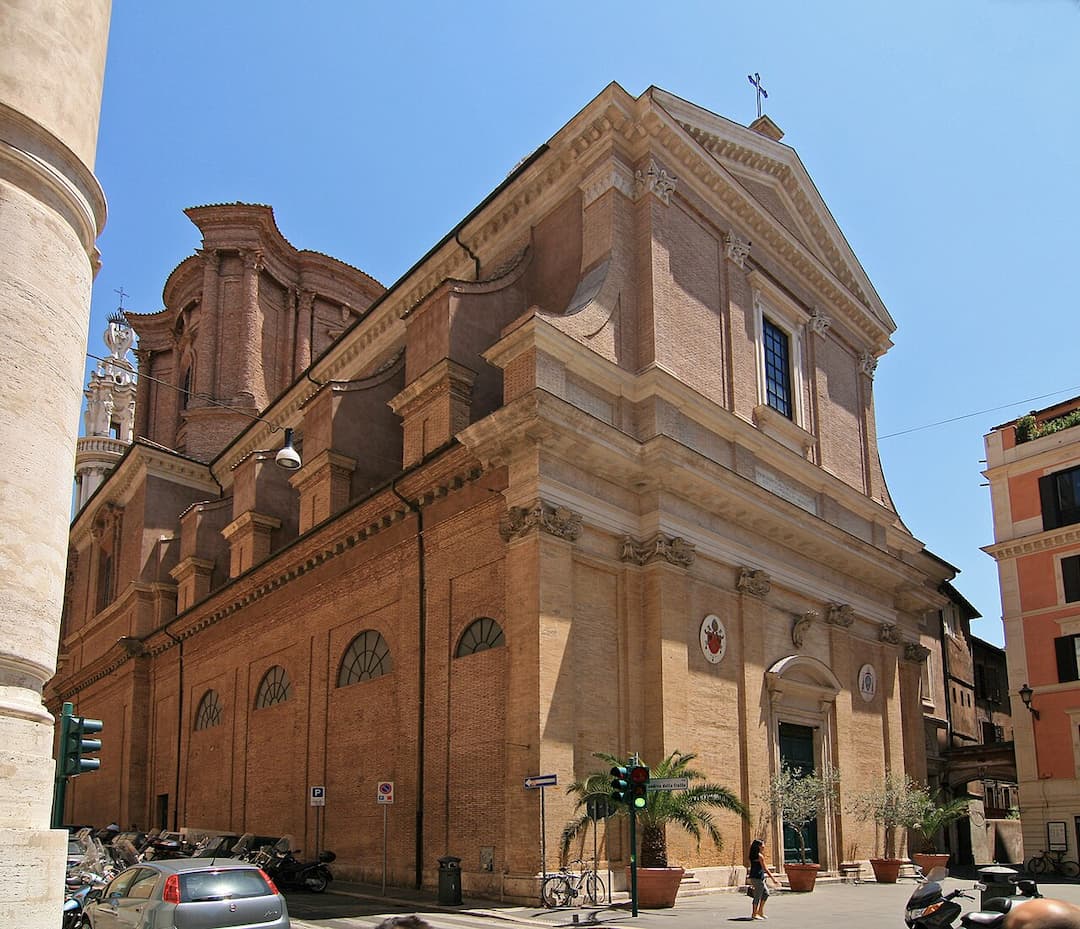
Location: A side chapel of the church of Sant’Andrea delle Fratte, Rome, Italy
Seer: Alphonse Ratisbonne
Approval Status: Vatican approved
Associated Basilica/Shrine: Basilica of Sant’Andrea delle Fratte
Also Known As: Madonna del Miracolo, Our Lady of the Miracle, and Notre Dame de Sion
Our Lady of the Miracle (Madonna del Miracolo), also known as Our Lady of Zion, is a Church-approved Marian apparition that occurred on January 20, 1842, in the church of Sant’Andrea delle Fratte in Rome, to Alphonse Ratisbonne, a young Jewish man wearing the Miraculous Medal on a friend’s challenge.
Who Was Alphonse Ratisbonne?
Alphonse Ratisbonne (1814–1884) was born in Strasbourg, France, into a prominent Jewish family. He had no religious faith of his own, and after his older brother Théodore became a Catholic priest, he grew openly hostile to Catholicism. On January 20, 1842, while visiting Rome, he saw the Blessed Virgin Mary in the church of Sant’Andrea delle Fratte and was baptized eleven days later. He became a priest, joined his brother in the work of the Congregation of Our Lady of Sion, and spent his last decades in Jerusalem, where he died in 1884.
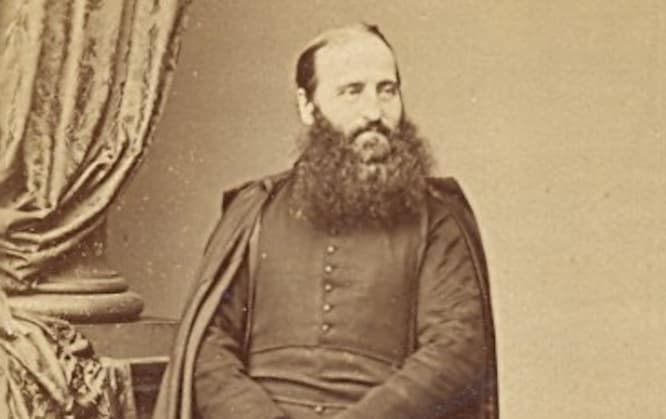
The Story of Our Lady of the Miracle
The Anti-Catholic Alphonse Ratisbonne
Alphonse Ratisbonne was the son of a wealthy Jewish banking family in Strasbourg. When Alphonse’s older brother converted to Catholicism and became a priest, Alphonse became adamantly anti-Catholic, bitter that his family had been torn apart. He even vowed never to speak to his brother, Fr. Marie-Théodore, again.
When he was 27 years old, he became engaged and decided to go on an extended holiday to improve his health before marriage. Originally, he had no intention of traveling to one of Catholicism’s most important cities. However, due to a mix up in his travel plans, he ended up in Rome on January 6, 1842, just as Catholics celebrated the Feast of the Epiphany.
Challenge by the Miraculous Medal
Not long after his arrival, Alphonse came upon an old college friend, a Protestant, who introduced him to his brother, Baron Théodore de Bussières who had converted to Catholicism. The Baron offered to show him around Rome and, noting the anti-Catholic rhetoric, challenged Alphonse to wear the Miraculous Medal and pray the Memorare for just one week as he toured the sites.
Alphonse relished the idea of proving Christianity to be a fraud. For the next few days, he enjoyed the company of the Baron as he toured Rome although he smugly wore the medal and prayed the prayer, confident this Catholic devotion was all make-believe.
A Friend’s Death
Several of his Catholic friends had all begun praying for his conversion. Then, one of those Catholic friends, the French Comte de la Ferronnays, suddenly passed away on January 17th of a heart attack. Baron Théodore de Bussières was placed in charge of the funeral details.
On January 20th, the Baron picked up Alphonse, letting him know of his friend’s death. They would have to go to the parish where the funeral would take place: the Church of Sant’Andrea delle Fratte. He promised to continue their tour once the plans were made. At first, Alphonse intended to wait outside for the Baron, but after a while, he changed his mind and wandered into the church on his own.
The Moment Grace Changed Everything
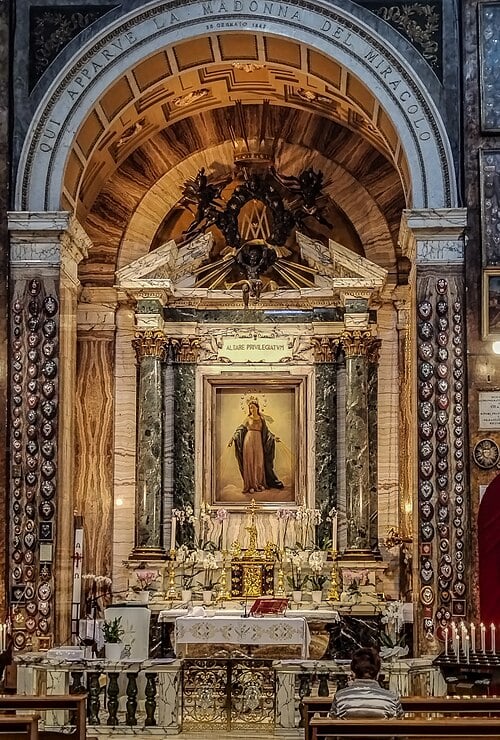
To Alphonse’s great surprise, as he approached the altar of the chapel, the Virgin Mary appeared to him. He later described the moment in his own words:
“In the midst of this radiance I saw standing on the altar, lofty, clothed with splendours, full of majesty and of sweetness, the Virgin Mary, just as she is represented on my medal.”1
Alphonse dropped to his knees. He glanced up several times but could raise his gaze only to her hands because he was so overcome with reverence and awe. He reported that even her hands expressed forgiveness and mercy.
“She spoke not a word, but I understood all.”2
When the apparition vanished, Alphonse stood up a completely changed man. His life would never be the same. No longer holding onto the bitterness, he embraced a profound new love of Mary, her Son, and the Church Jesus founded.
When the Baron found him afterwards clutching the Miraculous Medal and waving it around, Alphonse could barely speak but begged to be taken directly to a priest for confession. When interviewed, he grappled to explain how he, in the moment of the vision, felt as if he finally understood all of Christian theology. Eleven days later, on January 31, 1842, he was baptized in Rome, taking the name Marie.
A Life Rearranged
Alphonse did not receive a message to deliver to all of us, but his life became an authentic testament of God’s love, grace, and mercy.
Alphonse’s apparition happened in Rome. Many prominent clergy knew him, knew of his anti-Catholic views, his prominent family, and his conversion. Residents of Rome spoke with affection of the event as Madonna del Miracolo: Our Lady of the Miracle. Therefore an investigation was quickly opened. The apparition was canonically investigated in Rome and approved by decree on June 3, 1842, during the pontificate of Gregory XVI.
While we are not required to believe in any private revelations (CCC 66-67), we also need not respond to someone’s personal testimony with a spirit of fear, disdain, or anger. The Church allows us to listen to friends’ and converts’ experiences with gentleness, charity, prudence, and an openness to the possibility that Mary intervened in someone’s life: calling them closer to Christ, healing them, or directing their vocation.
Our Lady of the Miracle Signals Formation of Our Lady of Sion
Alphonse not only converted but broke off his engagement, reunited with his brother, and became a priest: Fr. Marie-Alphonse. He had no intention of being a leader for a Catholic order, but he did have a deep heart for the conversion of his people. He urged his brother, Fr. Marie-Théodore Ratisbonne, to do more for their plight.
Although older and more experienced in promoting the Gospel, Fr. Théodore Ratisbonne humbly took the apparition and his brother’s conversion as a call within his call to the priesthood; he understood that God wanted his ministry to focus on the conversion of their people and that everything he did going forward would revolve around his brother’s apparition. In 1843, Fr. Théodore began what would later be formally approved as the Congregation of Our Lady of Sion, a religious community dedicated to prayer and work for the conversion of Jewish people.
After the Second Vatican Council, the Congregation turned its mission toward fostering understanding between Jews and Christians.3 The order’s name, Our Lady of Sion (or Zion), reflected Fr. Théodore Ratisbonne’s belief that Mary had appeared to Alphonse because she loved the Jewish people. Even though the Catholic community of Rome called the apparition Our Lady of the Miracle, for the Ratisbonne brothers she was considered Our Lady of Sion because of the intimate call of the message to their hearts: she loved their people.
Why Mary Is Called the Daughter of Zion
The title comes from Scripture. The prophets called the faithful people of Israel the “daughter of Sion,” and the Church sees that title fulfilled in Mary, the Jewish daughter of Israel chosen to be the Mother of the Messiah (CCC 722). The prophet Sophonias sings, “Give praise, O daughter of Sion: shout, O Israel: be glad, and rejoice with all thy heart, O daughter of Jerusalem” (Sophonias 3:14, Douay-Rheims), and the angel Gabriel’s first word to Mary, “Hail,” is a greeting to rejoice. For the Ratisbonne brothers, the name said everything about the apparition: the Daughter of Zion, mother of a Jewish Messiah, had come to a son of her own people.
The Reconciled Brothers of Our Lady of Sion
At first Alphonse entered the Jesuits to receive his formal education and ordination, but even in this separation Fr. Théodore Ratisbonne humbled himself to his younger brother’s counsel. At one point, during the order’s early formation, a notary cheated Fr. Théodore out of a large sum of money.
At Christmas in 1844, Théodore traveled to Laval, dreading how to tell Alphonse the news. Alphonse listened with complete calm, then led his brother to the Christmas crèche, pointed to the straw where the Child Jesus lay, and said, “Here is our treasure!”4 Théodore later recalled how his brother helped him see that the work of Sion did not depend on money: the Blessed Mother, who had begun the work, would provide what it needed, and the brothers could entrust its present and future to her.
In 1852, Alphonse received permission from his own superiors to formally join his brother’s work in the Congregation of Our Lady of Sion. In 1855, Alphonse moved to Jerusalem, where he built the Ecce Homo convent on the Via Dolorosa, the monastery that still bears the Ratisbonne name, and a convent at Ein Karem.
Although the Congregation of Our Lady of Sion was not officially founded and approved on January 20, the order’s feast day became January 20th, the date of the apparition, celebrating Our Lady of Sion as the day Mary communicated her love for the Jewish people and her call to the Ratisbonne brothers.5 The two brothers Mary had brought back together with full reconciliation spent the rest of their lives working toward this goal of serving the Jewish world.
Death of Ratisbonne
On January 10, 1884, Fr. Marie-Théodore passed away. Fr. Marie-Alphonse, in poor health since childhood and now enduring deep grief, fell into a decline and died in Mary’s month, May of 1884, at Ein Karem, outside Jerusalem, where he is buried. His tombstone records that he did not fear death but longed for it, and that his ardent wish was “to die with the Memorare on my lips.”6
The Message and Call
The Blessed Mother said nothing to Alphonse Ratisbonne, although he felt as if he suddenly understood theology and doctrine in a profound swoop. This work of conversion, this outpouring of grace, can be seen as a continuation of the message of the Miraculous Medal.
At the heart of this encounter with Mary, stands a new convert to Catholicism, Baron Théodore de Bussières, who confidently believed in The Miraculous Medal and the unasked for graces Mary spoke of at Rue du Bac. Only a decade had passed since St. Catherine’s apparition experiences. She was still alive, working in anonymity and poverty in her vocation. All anyone knew were word of mouth stories surrounding the medal.
Baron Théodore de Bussières – suave, wealthy, sophisticated – did not challenge his friend to a debate or Bible study, ask his friend to read a particularly persuasive book, or invite his friend to a lecture series of a famous theologian.
Instead, this Baron challenged a skeptic to wear the simple Miraculous Medal and pray the simple Memorare. This bit of cheap metal flew in the face of the academic and philosophical high-mindedness of the time.
Frequently Asked Questions
Why did the Blessed Mother appear in Rome in 1842?
The Blessed Mother appeared to Alphonse Ratisbonne, a young man openly hostile to Catholicism, as he wore the Miraculous Medal at the challenge of a friend.
What are the spiritual fruits associated with Our Lady of the Miracle?
This particular apparition is itself the fruit of another apparition: Our Lady of the Miraculous Medal. The seer Alphonse Ratisbonne was an anti-Catholic who took up the challenge to wear the Miraculous Medal to disprove the Medal but instead was converted with dramatic grace.
Does Our Lady of the Miracle have a feast day?
No, while this apparition is approved by the Vatican, Our Lady of the Miracle/Our Lady of Zion does not have a global feast day on the Roman calendar. In Rome, January 20 is celebrated at the Basilica of Sant’Andrea delle Fratte to honor the anniversary of the apparition and the apparition is also given honor on November 27, the Feast of the Miraculous Medal.
Does the title Our Lady of the Miracle carry any special patronage?
Our Lady of the Miracle/Our Lady of Zion holds no other patronage other than those also associated with the Miraculous Medal.
Is Our Lady of the Miracle recognized by the Catholic Church?
Yes, Our Lady of the Miracle apparition was approved by the Catholic Church. Since this apparition happened in Rome, many in the Vatican knew the man to be anti-Catholic. The apparition was canonically investigated in Rome and approved by decree on June 3, 1842, during the pontificate of Gregory XVI.
Can I make a pilgrimage to Our Lady of the Miracle apparition site in Rome?
Yes, Rome is full of pilgrimage sites but you can also visit the site of this apparition at the Basilica of Sant’Andrea delle Fratte. St. Maximilian Kolbe celebrated his first Mass in this church in 1918.
What is the significance of the Miraculous Medal mentioned in this event?
The Miraculous Medal was significant to this event since the Baron challenged Alphonse Ratisbonne to wear the medal for one week. For more information on the medal’s origin, you can check out Our Lady of the Miraculous Medal, or pray the Miraculous Medal Novena.
Where is Alphonse Ratisbonne buried?
Fr. Marie-Alphonse Ratisbonne died in May 1884 at Ein Karem, outside Jerusalem, and is buried in the convent cemetery there.
Why is it called both Our Lady of the Miracle and Our Lady of Zion?
While the citizens of Rome, in their astonishment, gave the apparition the name Our Lady of the Miracle, the Ratisbonne brothers considered the apparition Our Lady of Sion. Her appearance not only converted Alphonse, but gave Fr. Théodore his call within his call to the priesthood. He considered the apparition a sign of Mary’s love for the Jewish people and gave the apparition date to the order as the order’s feast day, intimately linking the order with the apparition.
Conclusion: Living the Message Today
Today’s world is not so different than the world of Alphonse and the Baron. Pride and intellectualism still reign supreme. The Miraculous Medal and the conversion of Alphonse Ratisbonne remind us of Mary’s statement in the Magnificat of Luke 1:46-55:
“And Mary said: My soul doth magnify the Lord. And my spirit hath rejoiced in God my Saviour. Because he hath regarded the humility of his handmaid; for behold from henceforth all generations shall call me blessed…”
Her appearance, her distribution of graces, can humble the prideful in our own generation, if we place our confidence in God’s plan for the Blessed Mother.
To continue exploring, return to the full list of Marian Apparitions.
Notes
- Bussières, Théodore de. The Conversion of M. Marie-Alphonse Ratisbonne: Original Narrative. Edited by W. Lockhart. London: Burns and Oates, pp. 11–12. Internet Archive
- Ibid., p. 12.
- https://www.notredamedesion.org/know-us/our-story/
- https://www.ratisbonne.org.il/blog/uncategorized/feast-of-our-lady-of-sion-2/
- https://www.ratisbonne.org.il/blog/lectures/sion-facts/feast-of-our-lady-of-sion/
- https://www.ratisbonne.org.il/blog/lectures/sion-facts/140th-feast-day-of-fr-alphonse-marie-ratisbonnends/
- Image: Alphonse Ratisbonne, cropped, photograph by Foto Franck, Paris, 1865. Public domain, via Wikimedia Commons.
- Image: Chapel of the Madonna del Miracolo, Sant’Andrea delle Fratte, Rome, with Natale Carta’s 1842 painting of the Virgin as she appeared to Ratisbonne. Photo by GiulioTivoli, 2023, CC BY-SA 4.0, via Wikimedia Commons.