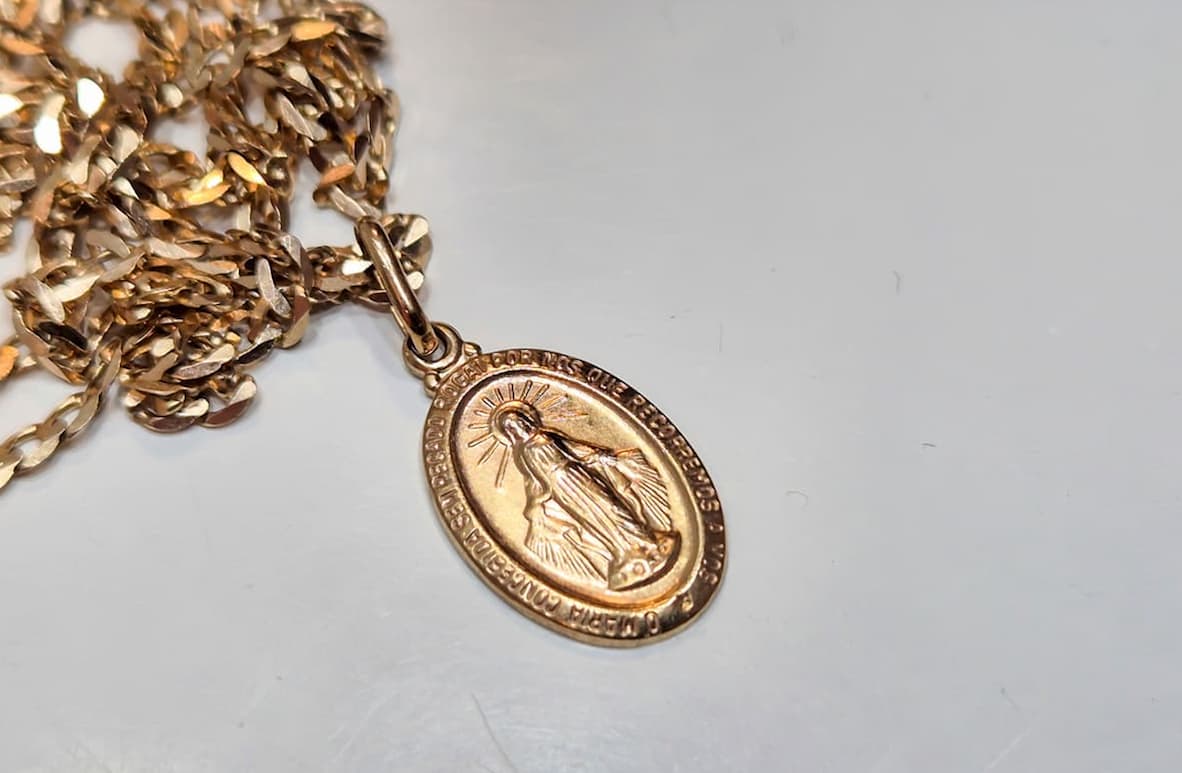
Over a billion Miraculous Medals have been distributed since 1832, it is very likely the most widely worn medal in the Catholic world. Yet many who wear it were never taught what its images mean, and here the medal is unlike any other devotional object: every element of its design was specified by Our Lady herself. Nothing on it is decoration. This guide explains what the Miraculous Medal is, what each symbol on the front and back means, the promise attached to wearing it, and how to wear and bless it.
What Is the Miraculous Medal?
The Miraculous Medal is a sacramental of the Catholic Church, a sacred sign, blessed by the Church, that disposes the wearer to receive God’s grace. Its official name is the Medal of the Immaculate Conception; the faithful themselves renamed it within a decade, when the healings and conversions granted through it grew too many to ignore.
Like every sacramental, the medal is not a charm and works no magic. It bears fruit through the intercession of Our Lady and the faith and confidence of the one who wears it, a truth Our Lady built into the medal’s own design, as we’ll see.
Where the Medal Came From
In 1830, at the motherhouse of the Daughters of Charity on the Rue du Bac in Paris, the Blessed Virgin Mary appeared to a young sister, St. Catherine Labouré, and showed her the design of a medal, asking that it be cast and promising great graces to those who would wear it. The first medals were struck in 1832 and given out during the cholera epidemic then ravaging Paris, and the graces that followed gave the medal its name.
What the Symbols on the Miraculous Medal Mean
Every image on the medal comes from the vision of November 27, 1830. Catherine first saw what became the front of the medal; then, as she watched, the image turned, and she saw the back. The two sides are one revelation, as an old devotional commentary puts it, the design is not the work of any human artist; it came from heaven, and Our Lady herself was its designer.
The Church’s old Mass for the medal’s feast chose its Introit with striking aptness: “It shall be as a sign in thy hand, and as a memorial before thy eyes” (Exodus 13:9). A sign in the hand: a pledge of belonging wholly to Mary Immaculate; a memorial before the eyes: a model to study and reproduce in one’s own life. That is what each symbol below is for.
The Front of the Medal
Mary standing on the globe. Our Lady stands upon a globe representing the world, and as she told Catherine, “each person in particular.” She is Queen of heaven and earth, and Mother of each soul individually. Beneath her feet on the medal’s design, the globe also recalls the golden globe Catherine saw her holding, which Mary offered to God as the whole world entrusted to her prayer.
The serpent crushed beneath her feet. Mary’s foot rests on a serpent, the ancient enemy of Genesis: “I will put enmity between thee and the woman, and thy seed and her seed: she shall crush thy head” (Genesis 3:15, Douay-Rheims). The medal proclaims that the battle foretold at Eden’s gate is real, and that it is already lost by the serpent.
The rays streaming from her hands. In the vision, rings on Mary’s fingers flashed with light streaming down upon the globe. “These rays,” she told Catherine, “are the symbols of the graces I shed upon those who ask for them.” Some gems, though, gave no light at all. These, Mary said, are the graces for which souls forget to ask. The rays on the medal are a standing invitation: ask.
The inscription. Framing the image are the words Our Lady herself composed:
O Mary, conceived without sin, pray for us who have recourse to thee.
This Miraculous Medal prayer professes the Immaculate Conception a full generation before the Church solemnly defined it in 1854 — and it names the medal’s one condition: recourse, made with confidence.
The year 1830. The date of the apparitions, stamped into the design at Our Lady’s request — the medal carries its own birth certificate.
The Back of the Medal
Notice first what the back does not have: an inscription. The devotional tradition holds that when the question of wording for the reverse was raised, the answer given was that no words were needed — the Cross, the M, and the two hearts say enough. The back of the medal is written entirely in symbols.
The M surmounted by the Cross. A large M — Mary’s initial — interwoven with a bar bearing the Cross. Mary stands inseparably beneath the Cross of her Son, as she stood on Calvary:
“There stood by the cross of Jesus, Mary His Mother” (John 19:25).
The classic commentaries on the medal love to point out how the two are joined: the monogram of Mary forms, as it were, a support and pedestal for the Cross — she does not stand beside her Son’s sacrifice but beneath it, upholding it, her whole role bound to it and never apart from it. The old writers summed her up in three words the M can carry at once: Mary, Mother, Mediatrix — the one through whose hands, as the front of the medal shows in rays of light, the graces of the Cross reach us.
The two hearts. Beneath the M are two hearts side by side: the Sacred Heart of Jesus, crowned with thorns, and the Immaculate Heart of Mary, pierced by a sword — the sword Simeon foretold:
“thy own soul a sword shall pierce” (Luke 2:35).
The medal places the two hearts together because that is how they beat: in love and in suffering, the tradition says, these two hearts are inseparable. As the Sacred Heart is the model and source of all holiness, the Immaculate Heart is its most faithful mirror — and the pair together preach a whole spirituality in miniature: His Passion was also hers, and ours, united to theirs, becomes redemptive too.
The twelve stars. Ringing the design are twelve stars — the apostles, and through them the whole Church gathered around Mary, the “Queen of Apostles”; and the crown of the woman of Revelation: “a woman clothed with the sun, and the moon under her feet, and on her head a crown of twelve stars” (Revelation 12:1). The old commentaries add a bracing point: the stars are not only a picture but a summons. To wear the medal is to be reminded of one of our chief obligations as Christians — to be apostles ourselves, by the example of our lives, our words, and our zeal — for “they that instruct many unto justice shall shine as stars for all eternity” (Daniel 12:3). The back of the medal is, in miniature, the Church’s whole picture of Mary: under the Cross, beside the Heart of her Son, crowned amid the apostles — and it asks the wearer to take a place in that crown.
Front and back together: the front shows Mary in relation to God — immaculate, victorious, interceding; the back shows her in relation to us — bound to the Cross, her heart beside her Son’s, surrounded by the Church. One medal, both truths. The classic commentaries go further still: the medal, rightly read, is a divine miniature of the whole faith — the fall of man in the serpent, redemption in the Cross, Mary’s universal motherhood in the M and the hearts, the life of grace in the rays, the Church and its mission in the stars. A catechism you can wear.
The Medal and the Immaculate Conception
The medal did not merely profess the Immaculate Conception, it helped prepare the Church to define it. For over twenty years before the dogma, millions of the faithful in nearly every language were praying the medal’s own words, “conceived without sin.” When Blessed Pius IX solemnly proclaimed the Immaculate Conception on December 8, 1854, twenty-four years after the Rue du Bac apparitions, the medal’s inscription had already made the doctrine the daily prayer of the Catholic world.
And heaven, it seems, closed the circle. Four years after the definition, at Lourdes, Our Lady told St. Bernadette: “I am the Immaculate Conception.” The medal prayed the doctrine, the Church defined it, and Our Lady confirmed it in her own voice.
The Promise of the Miraculous Medal
When Our Lady asked for the medal, she attached a promise to it:
“All who wear it will receive great graces; they should wear it around their neck. Graces will abound for those who wear it in confidence.”
Like every promise attached to a sacramental, this one must be understood as the Church understands it. The medal is not a talisman, and no object guarantees grace apart from faith. The Church has always insisted that sacramentals bear fruit through the prayer of the Church and the disposition of the one who uses them (CCC 1667–1670). Our Lady said as much herself: the graces abound for those who wear it in confidence. The main condition is trust.
Understood rightly, the promise has been kept extravagantly for nearly two centuries. The medal’s recorded fruits, healings, and above all, the conversions that renamed it, are presented by the Church not as articles of faith but as what they are: the visible harvest of a devotion Our Lady herself planted.
How to Wear the Miraculous Medal
The Miraculous Medal is the one medal whose wearing instructions come from Our Lady herself: “they should wear it around their neck.” On a chain or cord, over or under the clothing. The tradition asks only that it be worn, and worn in faith.
Unlike the brown scapular, the Miraculous Medal requires no enrollment. Any Catholic, indeed, anyone at all, may wear a blessed medal from the moment they receive it. (An optional investiture through the Association of the Miraculous Medal exists for those who want the fullest form of the devotion, but it is not required.) The medal has always been given freely and worn by non-Catholics as well; it was given for conversion, and some of its most famous graces came to those who wore it before they believed.
Blessing the Miraculous Medal
To be a sacramental, the medal must be blessed, an unblessed medal is simply metal. Any priest or deacon may bless it; a simple blessing suffices, and it takes only a moment after any Mass. If you bless and give medals to others (the oldest tradition of the devotion), have them blessed first.
Living the Devotion
To live the Miraculous Medal devotion is beautifully simple: wear the blessed medal, and pray its invocation with confidence: on waking, when you touch it, in moments of need. Many keep a few blessed medals to give away, continuing the tradition that began in the cholera wards of Paris: the medal is a gift meant to be given, especially to those far from God.
The devotion belongs to a remarkable family. From the same Daughters of Charity tradition, the same chapel, even the same spiritual director, came the Green Scapular a decade later; and the medal’s feast, November 27, crowns the Church’s month of remembering.
The medal’s whole genius is turning an ordinary day into a running conversation with Our Lady. If that daily rhythm is what you’re hungry for, BEHOLD, our new app for daily prayer with Fr. Chase Hilgenbrinck, was made for you.
Frequently Asked Questions
What does the Miraculous Medal mean?
The Miraculous Medal is a sacramental whose design was given by Our Lady herself in 1830: the front shows Mary immaculate and victorious — standing on the globe, crushing the serpent, with rays of grace streaming from her hands — and the back shows her bound to Christ and the Church: the M beneath the Cross, the two hearts, and twelve stars. Worn in faith, it is a continual act of recourse to Mary’s intercession.
What does wearing the Miraculous Medal mean?
Wearing the medal is a quiet profession of faith in the Immaculate Conception and an act of entrustment to Mary’s intercession, a “worn prayer.” Our Lady promised great graces to those who wear it around the neck with confidence.
Does the Miraculous Medal have to be blessed?
Yes. Like every sacramental, the medal must be blessed by any priest or deacon, with a simple blessing to carry the spiritual benefits of the devotion. An unblessed medal is simply metal.
Can non-Catholics wear the Miraculous Medal?
Yes. The medal has been given to and worn by non-Catholics from its earliest days. It was given for conversion, and many of its most celebrated graces came to people who wore it before they believed. Anyone may wear a blessed medal.
Is the Miraculous Medal the same as the scapular medal?
No. The scapular medal is a substitute for the cloth scapular, permitted since 1910 for those enrolled in a scapular. The Miraculous Medal is its own distinct sacramental, given through the 1830 apparitions, requiring no enrollment. Many Catholics wear both.
What are the twelve stars on the Miraculous Medal?
The twelve stars represent the twelve apostles, the Church gathered around Mary, and recall the woman of Revelation 12, “on her head a crown of twelve stars.” They frame the back of the medal as a sign of Mary crowned amid the Church.