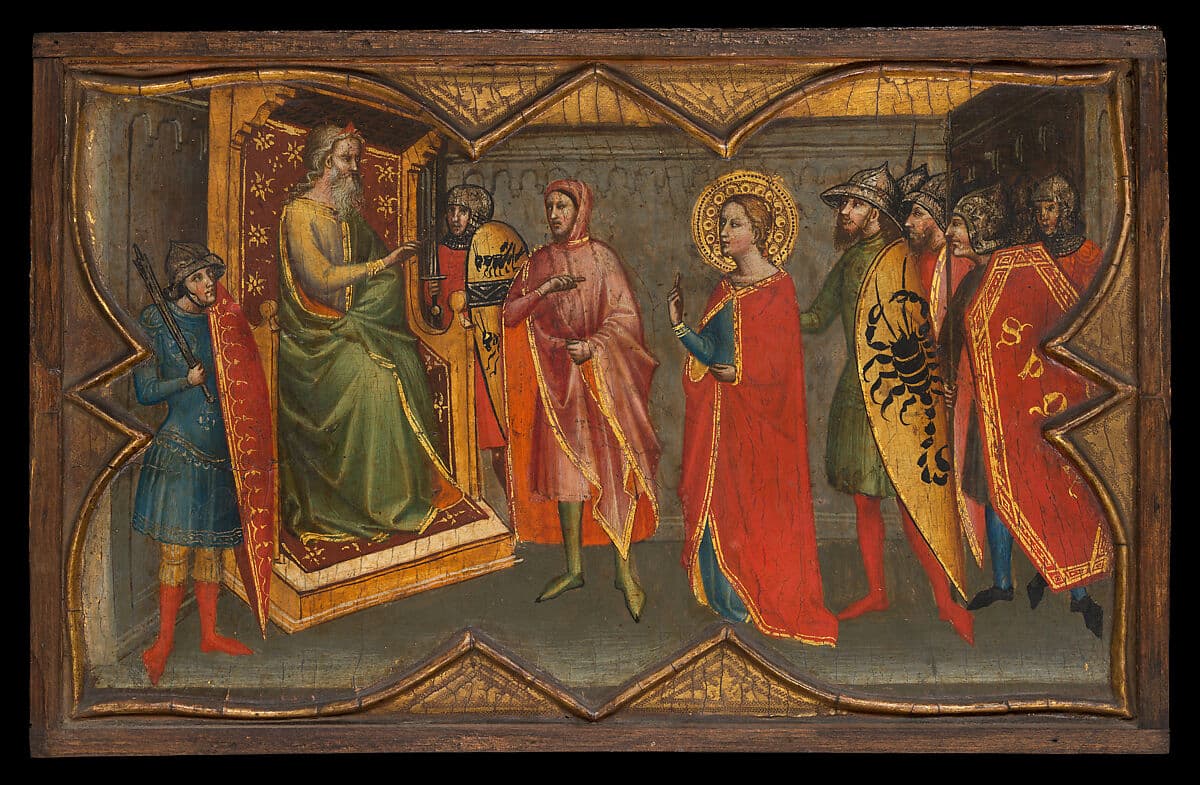
Image: Giovanni di Bartolommeo Cristiani, Saint Lucy before Paschasius, c. 1370s. The Metropolitan Museum of Art, Rogers Fund, 1912. Public domain.
St. Lucy (Santa Lucia) is the patron saint of eyes. A virgin martyr of Syracuse, Sicily, who died in the year 304, she is invoked by Catholics for eyesight, for the blind, and for every kind of eye disease, from cataracts to macular degeneration. Her feast day is December 13, and her name, from the Latin lux, means light.
If you came here looking for her prayer, it is on our Prayer to St. Lucy page. If you want to know who she was, why she is painted holding her own eyes on a plate, and how to ask her help, read on.
Why St. Lucy Is the Patron Saint of Eyes
Three things made Lucy the saint of sight.
Her name. Christians have always heard the word light in Lucia. The medieval Golden Legend begins her story with the line “In Lucy is said, the way of light,” and the Church’s own prayers to her ask for “a holy light” for the soul and “the light of our eyes” for the body. Her feast was fixed near the winter solstice, the darkest point of the year, and in Sweden and Sicily her day is still kept with candles and crowns of light.
Her eyes. According to tradition, Lucy’s eyes were gouged out during her martyrdom and miraculously restored. A later and better-known version says she removed them herself and sent them to a suitor who would not stop praising their beauty, and that God gave her new ones. Neither story appears in her earliest Acts, but by the Middle Ages they were everywhere, and they gave artists her unmistakable attribute: a pair of eyes held on a dish or sprouting from a stem.
Her answered prayers. Patronages are confirmed by the faithful, not just by legends. For centuries people with failing sight have prayed to St. Lucy and found help. The prayers approved for her by Pope Leo XIII in 1886 and Pope St. Pius X in 1907 ask directly for “the preservation of the light of our eyes,” so the Church’s own approved prayers confirm what the faithful already knew.
The Life of St. Lucy
Most of what we know of Lucy comes from her Acts, written well after her death and quoted by St. Aldhelm in the seventh century. The Church treats them as tradition rather than history. What is beyond doubt is that she was martyred at Syracuse around 304, that her cult was already ancient by the sixth century, and that her name was placed in the Canon of the Mass, where it remains today.
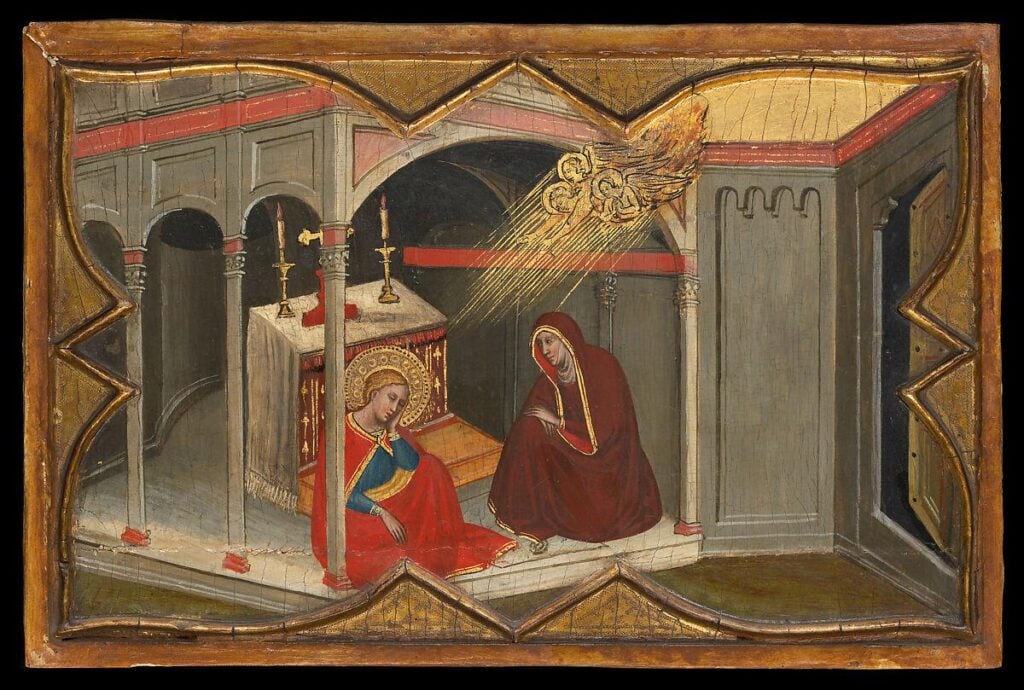
Giovanni di Bartolommeo Cristiani, Saint Lucy and Her Mother at the Shrine of Saint Agatha, c. 1370s. The Metropolitan Museum of Art, Rogers Fund, 1912. Public domain.
Her mother’s healing. Lucy was born to a noble Christian family in Syracuse. Her mother, Eutychia, had suffered for years from a hemorrhage no doctor could cure. Lucy persuaded her to make a pilgrimage to the tomb of St. Agatha in Catania, the martyr who had died there fifty years earlier. They prayed through the night. According to the Acts, St. Agatha appeared to Lucy in a vision and told her that her mother was already healed by her faith, and that Lucy would one day glorify Syracuse as Agatha had glorified Catania.
Giving everything to the poor. Lucy had secretly vowed her virginity to Christ, but her mother had arranged a marriage to a wealthy pagan. On the road home from Catania, Lucy told her mother the truth and asked that her dowry be given to the poor. Her mother suggested waiting until after her own death. Lucy’s answer, preserved in her Acts, has been quoted ever since: “Whatever you give away after your death you give because you cannot take it with you. Give now, to the True Savior, while you are healthy, whatever you intended to give away at your death.” They sold the property and distributed the money to the poor of Syracuse.
Before the judge. The rejected suitor denounced Lucy as a Christian to Paschasius, the Roman governor, during the persecution of Diocletian. Ordered to sacrifice to the idols, she refused. The Breviary records their exchange. When Paschasius threatened that “words will cease when we come to blows,” Lucy replied that God’s servants never lack words, quoting Christ’s promise that “it is not you that speak, but the Spirit of your Father that speaketh in you” (Matthew 10:20). When he asked whether the Holy Spirit was in her, she answered: “They that live in chastity and piety are the temples of the Holy Ghost.”
The oxen, the fire, the sword. Paschasius ordered her taken to a brothel. According to tradition, the guards could not move her, and neither could a team of oxen. He had pitch and oil poured over her and set alight; the fire did not burn her. At last a soldier drove a sword through her throat. Before she died she foretold peace for the Church and the fall of Diocletian. It was December 13, 304.
Her relics. Lucy was buried at Syracuse, where her tomb became a place of pilgrimage. Her body was later carried to Constantinople and, after the Fourth Crusade, to Venice, where it rests today in the church of San Geremia. Pieces of her relics are venerated in Syracuse, which still keeps her feast as its greatest day of the year.
St. Lucy in Art: Eyes on a Plate, the Palm, the Lamp
You can recognize St. Lucy at a glance in almost any church or museum. Look for:
- A pair of eyes on a dish, a cup, or, as in Francesco del Cossa’s painting above, growing from a stem like a flower. This is her unique attribute, and no other saint carries it.
- A palm branch, the sign of every martyr.
- A dagger or sword at her throat, the instrument of her death.
- A lamp or candle, for her name, and for the wise virgins of the Gospel who kept their lamps lit for the Bridegroom.
- Oxen in the background, straining at ropes that cannot move her.
Why Catholics hear her name at Mass. Lucy is one of seven women saints named in the Roman Canon, the first Eucharistic Prayer: “Felicity, Perpetua, Agatha, Lucy, Agnes, Cecilia, Anastasia.” She has been there since at least the time of Pope St. Gregory the Great, around the year 600.
Devotion to St. Lucy Today
Fr. Jeffrey Kirby, speaking with Adam Wright on Covenant Network’s Roadmap to Heaven, described St. Lucy as a saint who “picked” him early in his priesthood. He has prayed with people who were told they would lose their sight, asked for her intercession alongside the Anointing of the Sick, and seen restorations that doctors could only call “unexplainable by contemporary medical science.” You can hear the whole conversation here.
Her devotion has a seasonal rhythm. In Sweden, Norway, and parts of Italy, December 13 is Santa Lucia Day, kept with processions of girls in white carrying candles, a custom that grew up because her feast once fell on the shortest day of the year. In Advent, when the Church is waiting for the Light of the World, St. Lucy is a small lamp lit along the way.
When to pray to St. Lucy
- Before an eye exam, a diagnosis, or surgery (cataract, retinal, LASIK, glaucoma)
- For a child’s vision, or for parents and grandparents losing their sight
- For anyone who is blind or partially sighted, and for those who care for them
- For eye strain, headaches, and the hours we spend looking at screens
- For “spiritual sight”: clarity in a decision, light in a dark season, protection from temptation
For the prayer for eye problems, the feast-day collect, and how to pray them, see our full Prayer to St. Lucy page. For a serious intention, pray the St. Lucy Novena for nine days.
Frequently Asked Questions
Is St. Lucy the only patron saint of eyes?
She is the principal one. According to tradition, St. Odilia of Alsace, born blind and healed at her baptism, is also invoked by the blind, and St. Raphael the Archangel, who healed Tobit’s blindness, is a patron of healing in general. St. Clare of Assisi is the patroness of television, not of eyesight.
When is St. Lucy’s feast day?
December 13, in Advent. The St. Lucy Novena runs December 4 to 12.
What does the name Lucy mean?
Lucy comes from the Latin lux, “light.” Lucia, Lucie, Luce, and Lucinda are forms of the same name.