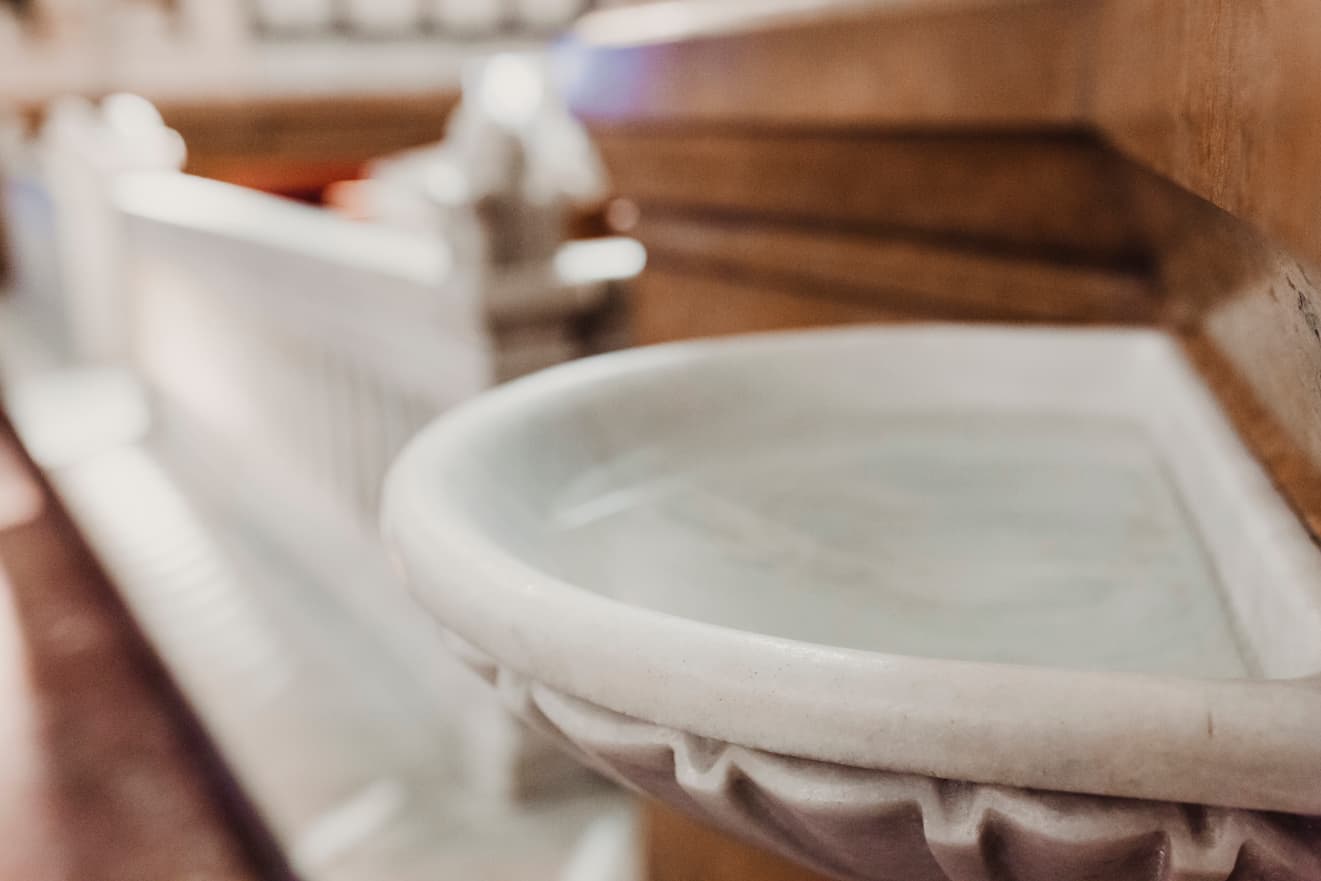
Holy water at the door of a church. A blessed crucifix hanging on a wall. Ashes on the forehead, a rosary in the hand, a scapular resting over the shoulders. These are sacramentals, the sacred signs woven through the daily life of the Catholic faithful. They are among the most familiar features of Catholic devotion, and also among the least understood. This guide explains what a sacramental is, how sacramentals differ from the seven sacraments, why the Church gives them to us, and where to explore each of the great families of sacramentals in depth.
The Catechism of the Catholic Church defines sacramentals as "sacred signs which bear a resemblance to the sacraments" and "by which men are disposed to receive the chief effect of the sacraments, and various occasions in life are rendered holy" (CCC 1667). A sacramental is something the Church sets apart and blesses, an object, a blessing, or a sacred action, in order to sanctify a moment of life and dispose the soul to grace.
Sacramentals take several forms. Some are blessings, by which persons, meals, homes, vehicles, and objects are consecrated to God. Some are objects that have been blessed and set apart for devotion, such as scapulars, medals, rosaries, crucifixes, holy water, and blessed candles. And some are sacred actions, such as the Sign of the Cross or the sprinkling of holy water. In every case, the sacramental joins a visible sign to the prayer of the Church.
It is easy to confuse sacramentals with sacraments, but the distinction is important and the Church is careful about it.
The seven sacraments, Baptism, Confirmation, the Eucharist, Penance, the Anointing of the Sick, Holy Orders, and Matrimony, were instituted by Christ himself. They confer the grace they signify, and they do so ex opere operato, that is, by the very fact that the sacred action is performed, through the power of Christ working in them. The sacraments are the ordinary and certain channels of God's grace.
Sacramentals, by contrast, were instituted by the Church, not directly by Christ, and they work in a different way. They do not confer grace by themselves. Rather, as the Catechism teaches, they prepare and dispose us to receive the grace of the sacraments and cooperate with it (CCC 1667–1670). Their fruit depends on the faith and devotion of the one who uses them and on the intercessory prayer of the Church. A sacramental is not a lesser sacrament; it is a different kind of gift, one that surrounds the sacramental life of the Church and extends its sanctifying reach into the ordinary hours of the day.
Because sacramentals involve blessed objects and prescribed prayers, they are sometimes misunderstood, both by Catholics who may treat them superstitiously and by critics who dismiss them as magical thinking. The Church rejects both errors.
A sacramental is not a charm, an amulet, or a talisman. It has no power of its own, and no object can compel God or substitute for genuine faith and repentance. To treat a scapular or a medal as a lucky token, or to imagine it will save a soul apart from a life turned toward God, is a real distortion of the devotion and something the Church consistently warns against.
At the same time, sacramentals are not empty. They are effective in the way the Church says they are effective: they stir up devotion, they draw the mind and heart toward God, they invoke the powerful intercession of the Church and of the saints, and they dispose the soul to receive grace. Their power is the power of prayer and of faith, joined to a visible sign that the Church has blessed. Understood rightly, a sacramental is a form of prayer made tangible.
The Church gives sacramentals because we are not pure spirits but body and soul together, and God meets us through both. Just as the sacraments use water, oil, bread, and wine, so the wider life of the Church uses tangible signs to sanctify the whole of human existence. A blessing over a home, a medal worn against the heart, holy water at the threshold, these carry the presence of prayer into the places and moments where we actually live.
Sacramentals also keep the life of grace continuous. The sacraments are received at particular moments; sacramentals fill the spaces between, turning ordinary actions into occasions of devotion and reminding us, hour by hour, of God and of the communion of saints. In this way the Church surrounds her children with sacred signs, so that, as the Catechism says, "there is scarcely any proper use of material things which cannot be thus directed toward the sanctification of men and the praise of God" (CCC 1670).
The sacramentals of the Church are many. Below are the principal families of devotional sacramentals, each explored in depth in its own guide.
The scapular is a small devotional garment worn over the shoulders, a miniature of a religious habit, by which a lay Catholic shares in the spirituality and protection of a religious order or a Marian devotion. The brown scapular of Our Lady of Mount Carmel is the most beloved, but there are many others, including the green scapular given for the conversion of sinners. Our complete guide covers the history, meaning, promises, and proper use of each.
Among the richest of sacramentals are the Church's blessings, by which homes, vehicles, food, throats, animals, and countless occasions of ordinary life are consecrated to God. From the blessing of a home to the blessing of throats on the feast of St. Blaise, these bring the sanctifying prayer of the Church into daily life.
Blessed medals, worn as signs of faith and devotion, are among the most widely used sacramentals. The Miraculous Medal, the medal of St. Benedict, and many others carry centuries of devotion and the intercession of the saints they honor.
The Catholic home is meant to be a domestic church, and the Church provides many sacramentals to sanctify it: holy water, blessed candles, the crucifix, the Advent wreath, images of the Sacred Heart, and more.
For quick reference, here are many of the sacramentals a Catholic may encounter, grouped by kind:
Blessed objects: scapulars, medals (Miraculous Medal, St. Benedict medal, and others), rosaries, crucifixes and crosses, holy water, blessed salt, blessed candles, blessed palms, ashes, relics, images and statues, the Advent wreath.
Blessings: the blessing of persons, homes, vehicles, food, animals, throats (St. Blaise), fields and seeds, and countless occasions of daily life.
Sacred actions: the Sign of the Cross, genuflection, the sprinkling of holy water (the Asperges), the use of blessed ashes and palms, and other prescribed gestures of devotion.
To intentionally live with sacramentals is to bring the sacred into all of the moments of daily life. A Catholic who wears a blessed medal, keeps holy water at home, has the family car blessed, and prays with a scapular is not collecting lucky charms but weaving prayer through the fabric of ordinary days. Used with faith, sacramentals draw us continually toward the sacraments, toward the saints, and toward God himself. They are the Church's way of sanctifying not only the great moments of life but every moment in between.
What are sacramentals in the Catholic Church? Sacramentals are sacred signs, objects, blessings, or actions, instituted by the Church to dispose the faithful to receive grace and to sanctify various occasions of life. Examples include scapulars, medals, holy water, blessed candles, and the Sign of the Cross.
What is the difference between a sacrament and a sacramental? The seven sacraments were instituted by Christ and confer grace by the very fact of the sacred action performed. Sacramentals were instituted by the Church and do not confer grace by themselves; they prepare and dispose the faithful to receive grace through faith and the prayer of the Church.
Do sacramentals have power? Sacramentals have no power of their own and are not charms. Their effectiveness comes from the prayer of the Church, the intercession of the saints, and the faith and devotion of the one who uses them, all of which dispose the soul to receive God's grace.
Are sacramentals in the Bible? While the word "sacramental" is not in Scripture, the use of blessed objects and sacred signs is deeply biblical, from the blessing of objects for worship in the Old Testament to the healing power that flowed through cloths touched to St. Paul in the Acts of the Apostles (Acts 19:11–12).
How many sacramentals are there? Sacramentals cannot be counted like the seven sacraments, because the Church can institute and bless a great variety of them. They include many blessed objects, a vast number of blessings, and various sacred actions.
Do sacramentals need to be blessed? Blessed objects used as sacramentals are blessed by a priest; the blessing is what sets them apart for sacred use. Blessings and sacred actions are themselves sacramentals by their nature as prayers of the Church.
No Subscriptions, NoPaywall, 100% Free!
Experience the richness of our Catholic Faith with the free Covenant Network app, now available on your iPhone or Android.


No Subscriptions, NoPaywall, 100% Free!
Experience the richness of our Catholic Faith with the free Covenant Network app, now available on your iPhone or Android.


An initiative of Covenant Network
A new app for daily prayer and the interior life, coming to iOS.