Top image: Rufus46, CC BY-SA 4.0 https://creativecommons.org/licenses/by-sa/4.0, via Wikimedia Commons
For nearly eight hundred years, Catholics have worn a small cloth devotion close to the heart as a silent prayer and a sign of consecration. The scapular is one of the most beloved sacramentals of the Church, yet many of the faithful who wear one have never been taught what it truly is, where it came from, or how the Church understands its promises. This guide answers those questions, drawing on the tradition of the Church and the teaching of the Magisterium, and points you toward deeper resources on each individual scapular.
What Is a Scapular?
The word scapular comes from the Latin scapulae, meaning the shoulders. In its original form, the scapular was a long, wide band of cloth worn over the shoulders by monks, hanging down the front and back of the body over the rest of the religious habit. It began as a purely practical garment: an apron that protected a monk’s clothing during manual labor.
Over time, this working garment took on a profound spiritual meaning. In the Rule of St. Benedict, written in the sixth century, the scapular is mentioned among the items of the monastic habit, and it came to be understood as a symbol of the religious life itself, the “yoke of Christ” taken upon the shoulders. When a monk or friar put on the scapular, he was putting on his commitment to labor for the Kingdom of God.
From this monastic origin grew the devotional scapular worn by the laity today: two small pieces of cloth joined by two cords or bands, worn over the shoulders so that one piece rests on the chest and the other on the back. The small scapular is a miniature of the full religious scapular, allowing lay Catholics to share in the spirituality and protection of a religious order without entering the cloister.
What a Scapular Means: A Sacramental, Not a Charm
The scapular is a sacramental, a sacred sign blessed by the Church that disposes the soul to grace. It is not one of the seven sacraments, which were instituted by Christ and confer grace by the very fact of the sacred action; rather, like every sacramental, the scapular prepares us to receive grace and cooperate with it through the prayer of the Church and the faith of the one who wears it.
The scapular is not a magic charm, and wearing it is not a guarantee of salvation apart from a life of faith. The Church has always insisted that the promises attached to the scapular presuppose a genuine spiritual life: faith, devotion, and cooperation with the grace God offers. Grace does not overpower the free will; it enlightens and strengthens us, but we must say yes to it.
Understood rightly, then, the scapular is best thought of as a worn prayer, a continual silent petition and a sign of one’s consecration to Christ through the hands of His Mother. It is not the cloth that saves, but the living faith the cloth expresses and the grace to which it disposes the wearer.
A Brief History of the Scapular Devotion
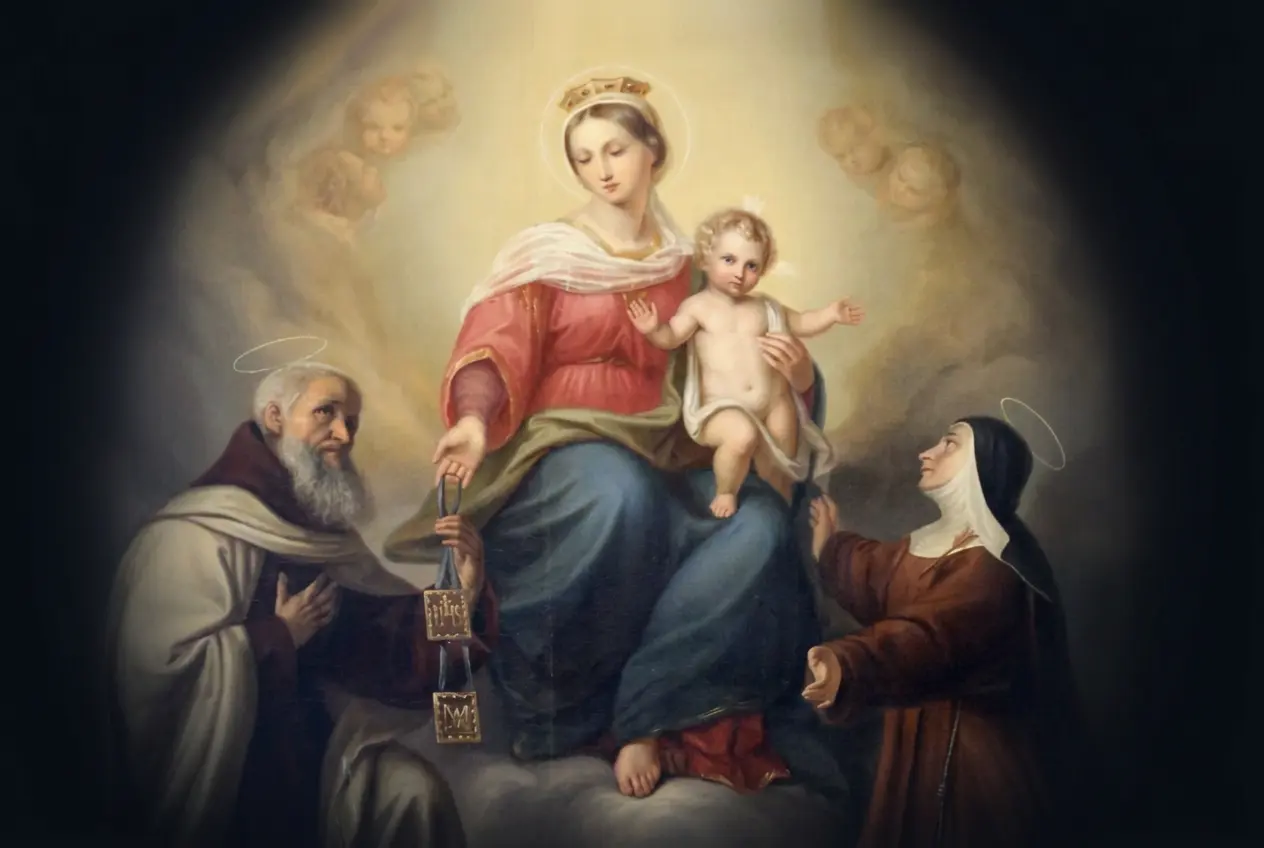
The devotional scapular as we know it is rooted most deeply in the Carmelite Order and the tradition of Our Lady of Mount Carmel: according to Carmelite tradition, the Blessed Virgin Mary presented the brown scapular to St. Simon Stock in 1251 as a sign of her protection, and from that event the devotion spread throughout the Church. Over the centuries, other religious orders received approval to confer their own scapulars upon the laity, around eighteen approved small scapulars in all, each tied to a particular devotion, grace, and spirituality.
Types of Catholic Scapulars
While there are many approved scapulars, a handful account for nearly all devotion among the faithful today. Below is an overview of the principal scapulars, each of which is treated in full on its own page.
The Brown Scapular
The brown scapular, also called the Scapular of Our Lady of Mount Carmel, is by far the most widely worn and the most important. It is tied to the Carmelite Order and to the promises associated with the apparition to St. Simon Stock. For most Catholics, “the scapular” means the brown scapular.
The Green Scapular
The green scapular arose from apparitions of the Blessed Virgin Mary to Sister Justine Bisqueyburu of the Daughters of Charity in the mid-nineteenth century. It is distinct from the others in that it need not be worn by the person it is meant to help; it is especially associated with the conversion of those who have fallen away from the faith and with the grace of a holy death.
The Minor Scapulars
Several other approved scapulars, distinguished by their colors and the orders that confer them, complete the family of devotional scapulars: the red scapular of the Passion, the blue scapular of the Immaculate Conception, the black scapular of the Seven Sorrows of Mary, and the white scapular of the Most Holy Trinity, among others. Each carries its own history and devotion.
How to Wear a Scapular
A scapular is worn over the shoulders, beneath or over the clothing, so that one panel of cloth rests against the chest and the other against the back — not as a necklace or bracelet. To be a true sacramental it must be blessed, and for most scapulars the wearer is also enrolled (invested) once by a priest. The full rules of wearing, blessing, enrollment, and care are explained on the page for each scapular, beginning with the brown scapular, whose practice the others largely follow.
The Scapular Medal
Since 1910, the Church has permitted a blessed scapular medal to be worn in place of the cloth scapular, though the cloth remains the traditional and preferred form of the devotion. The history of this permission and the conditions for its use will be explained on a dedicated page in the future.
Living the Devotion Today
The scapular is, at its heart, a small and humble thing: two pieces of cloth and a cord. But like the Rosary, its power lies not in the object itself but in what it signifies and what it draws us toward. To wear the scapular faithfully is to carry a continual prayer upon the body, to offer one’s daily labor to Christ, and to entrust oneself to the protection of His Mother. It is, in a sense, a devotion you can wear, an act of consecration renewed with every hour it rests against the heart.
Whether you are drawn to the brown scapular of Our Lady of Mount Carmel, the green scapular for the conversion of a loved one, or one of the other approved scapulars of the Church, the invitation is the same: to take up the yoke of Christ and to walk through each day under the mantle of Mary.
Frequently Asked Questions
Which scapular should I wear?
For most Catholics, the brown scapular of Our Lady of Mount Carmel is the natural place to begin — it is the most widely worn and the model for all the others. If your heart is drawn to a particular grace, choose accordingly: the green scapular for the conversion of a loved one, the red for devotion to the Passion, the blue for the Immaculate Conception, the black for the Sorrows of Mary, or the white for the Most Holy Trinity. It is better to live one devotion deeply than to collect many.
How many Catholic scapulars are there?
The Church has approved around eighteen small devotional scapulars over the centuries. The most widely worn are the brown and the green, followed by the red, blue, black, and white scapulars.
Can I wear more than one scapular at a time?
Yes. A person may be enrolled in and wear several scapulars at once. The Fivefold Scapular exists precisely to combine five of the approved scapulars into a single garment.