Few Catholic devotions are surrounded by as much love, and as much confusion, as the promises of the brown scapular. Some may say the scapular is a guarantee of Heaven; others have heard of a mysterious “Saturday privilege” without knowing what it means; and a great many have seen the phrase “15 promises of the brown scapular” online without realizing it rests on a misunderstanding. This page explains what the Church actually teaches about the promises of the brown scapular, drawing on the decrees of the Holy See and the tradition of the Carmelite Order, so that the devotion may be lived in truth rather than fall into superstition.
Are There Really 15 Promises of the Brown Scapular?
There are, in the authentic Catholic tradition, two principal promises associated with the brown scapular: the Scapular Promise and the Sabbatine Privilege. Everything else that circulates as a numbered list of scapular promises should be approached with care.
A word first about the “15 promises.” Many websites list “15 promises of the brown scapular,” but this is almost always a confusion with the fifteen promises of the Rosary, which are traditionally attributed to the Blessed Virgin Mary through Blessed Alan de la Roche. Those fifteen promises belong to the Rosary, not to the scapular. The brown scapular’s authentic tradition centers on the two promises explained below. It is worth stating this plainly, because devotion built on a misunderstanding is fragile, while devotion built on the truth of the Church endures.
The Scapular Promise
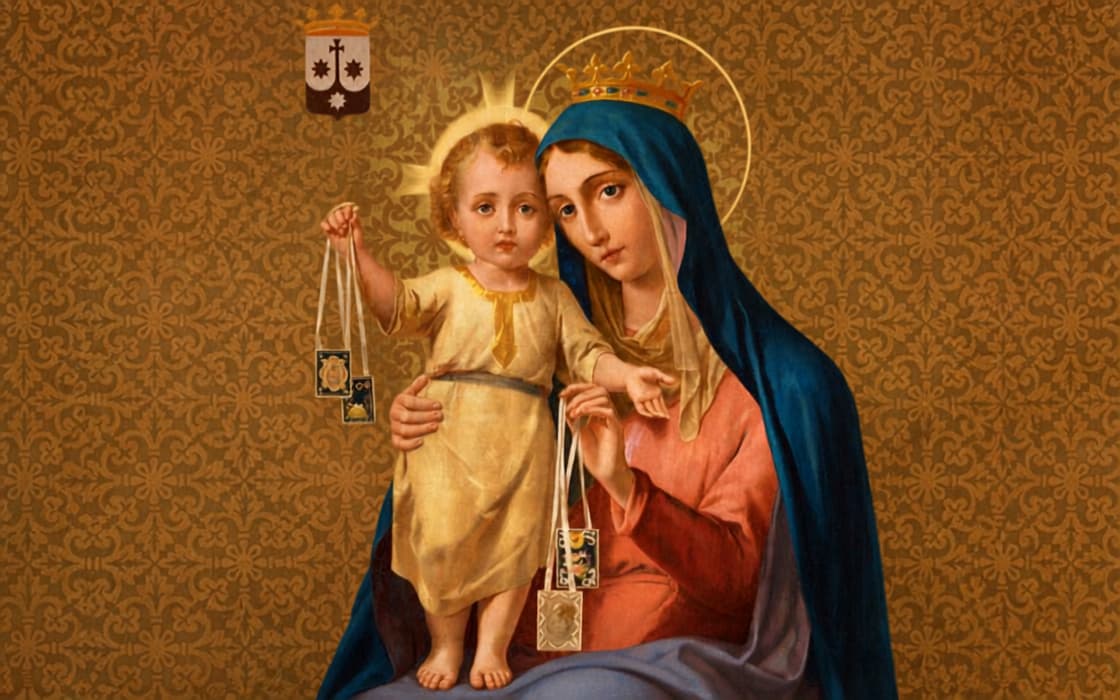
The first and most important promise is the one traditionally attributed to Our Lady’s words to St. Simon Stock in 1251. According to Carmelite tradition, Mary presented the scapular and promised:
“Whosoever dies clothed in this scapular shall not suffer eternal fire.”
This is the promise most Catholics have in mind when they speak of “the scapular promise.” Its meaning, however, must be understood carefully and in harmony with the whole of Catholic teaching.
The promise is not a guarantee of salvation regardless of how one lives. The scapular is a sacramental, and like every sacramental it bears fruit according to the faith and devotion of the one who wears it. The promise presupposes that the wearer lives and dies in the friendship of God. Understood rightly, the Scapular Promise is an expression of confidence that Mary will obtain for her faithful children the grace of final perseverance, the grace of dying in a state of grace. It is a promise of her maternal intercession for those who entrust themselves to her, not a substitute for a life of faith.
Understood this way, the Scapular Promise contradicts nothing in Catholic teaching. The Church has always held that no one can presume upon salvation, and that perseverance to the end is itself a gift of God’s grace. Mary’s promise is precisely a promise to obtain that gift for those who wear her scapular in genuine devotion.
The Sabbatine Privilege
The second promise, the Sabbatine Privilege, concerns Our Lady’s intercession for the souls of scapular wearers after death. Its name comes from the Latin sabbatum, meaning Saturday, the day the Church dedicates to the Blessed Virgin Mary. This is the promise sometimes searched for as the “Saturday privilege” of the scapular.
The Sabbatine Privilege has a genuinely complex history, and honesty about that history is essential. The privilege was originally tied to an alleged papal bull, Sacratissimo uti culmine, attributed to Pope John XXII and dated 1322, which recounted an apparition of Our Lady promising to deliver from Purgatory, on the Saturday after death, the souls of those who died wearing the scapular and fulfilled certain conditions. Scholars, including Catholic scholars, have long regarded that particular bull as historically unfounded and most likely a later forgery. The Church has never required belief in the apparition to Pope John XXII, and the Carmelite Order today does not preach the story as historical fact.
What the Church does permit the faithful to believe was set down authoritatively in a decree of the Holy Office issued under Pope Paul V on January 20, 1613. That decree permits Catholics to piously believe that the Blessed Virgin Mary will assist, by her continual intercession, merits, and special protection, the souls of members of the Scapular Confraternity who have departed this life in the grace of God, especially on Saturday, the day consecrated to her, provided they fulfilled certain conditions in life.
This 1613 decree, not the disputed 1322 bull, is the true foundation of what a Catholic believe about the Sabbatine Privilege. It presents the privilege not as a mechanical guarantee but as a pious and confident hope in Mary’s powerful intercession for the souls in Purgatory who were faithful to her devotion.
The Conditions of the Sabbatine Privilege
According to the tradition expressed in the 1613 decree, three conditions were attached to the Sabbatine Privilege:
- First, the faithful wearing of the brown scapular, having been duly enrolled.
- Second, the observance of chastity according to one’s state in life. This does not forbid marriage; it means that the wearer, married or single, strives to live purely according to his vocation and repents promptly when he falls.
- Third, the daily recitation of the Little Office of the Blessed Virgin Mary. For those unable to read, this condition was traditionally fulfilled by observing the fasts of the Church and abstaining from meat on Wednesdays and Saturdays. By a decree of the Congregation of Indulgences under Pope Leo XIII in 1901, any priest with the proper faculties may commute this third condition to another pious work, most commonly the daily recitation of five decades of the Rosary. In practice, most lay people simply ask a priest to approve this substitution.
Are the Promises Guaranteed?
This is the question most people are really asking, and it deserves a clear and honest answer.
The promises of the brown scapular are not magic, and they are not automatic. The scapular is not a talisman, and no sacramental can save a person who dies estranged from God by unrepented grave sin. The Church has consistently taught this, and faithful Carmelite catechesis insists on it.
At the same time, the promises are not empty. They express the constant faith of the Church in the maternal intercession of Mary. To wear the scapular devoutly is to entrust oneself to her, and the tradition holds with great confidence that she will not abandon those who wear her livery, but will obtain for them the graces they need, above all the grace of final perseverance and, for the faithful departed, her powerful intercession before the throne of God.
Living the Promises Faithfully
The right way to receive the promises of the brown scapular is neither to dismiss them nor to treat them superstitiously, but to let them draw us into the life they presuppose: a life of faith, purity according to one’s state, prayer, and trust in Our Lady. The scapular is an outward sign of an inward fidelity. Worn in that spirit, it becomes what Our Lady intended, a pledge of her care and a continual reminder to live for her Son.
To wear the scapular faithfully, a Catholic should be properly enrolled, wear the blessed scapular continually, and strive to live the devotion through prayer and a good life.
Frequently Asked Questions
What are the promises of the brown scapular?
There are two principal promises in Catholic tradition: the Scapular Promise, that whoever dies clothed in the scapular, in the friendship of God, will be preserved from eternal fire; and the Sabbatine Privilege, a pious belief in Mary’s special intercession for the souls of faithful scapular wearers after death, especially on Saturdays.
Are there really 15 promises of the brown scapular?
No. The “fifteen promises” belong to the Rosary, not the scapular, and are traditionally attributed to Blessed Alan de la Roche. The brown scapular’s authentic tradition centers on the Scapular Promise and the Sabbatine Privilege.
Does wearing the brown scapular guarantee you go to Heaven?
No. The scapular is a sacramental, not a guarantee of salvation. Its promises presuppose that the wearer lives and dies in the grace of God. It is a pledge of Mary’s intercession to obtain the grace of final perseverance, not a substitute for a life of faith.
What is the Saturday privilege of the scapular?
The “Saturday privilege” is another name for the Sabbatine Privilege, so called because Saturday is the day dedicated to Our Lady. It refers to the pious belief that Mary especially assists the souls of faithful scapular wearers in Purgatory, particularly on Saturdays.
Do I have to say the Little Office to gain the Sabbatine Privilege?
Traditionally yes, but since 1901 a priest may commute this to another pious work, most commonly the daily Rosary. Most lay people simply ask a priest to approve the substitution.