Top image source: Sarah sofía at English Wikipedia, CC BY-SA 3.0 http://creativecommons.org/licenses/by-sa/3.0/, via Wikimedia Commons
The brown scapular is the most widely worn devotional sacramental in the Catholic Church. For most of the faithful, when they speak of “the scapular,” it is the brown scapular they mean. Worn quietly beneath the clothing as two small pieces of brown wool resting over the shoulders, it is at once a sign of consecration to the Blessed Virgin Mary, a participation in the spirituality of the Carmelite Order, and a continual prayer carried upon the body. This guide explains what the brown scapular is, where it comes from, what it means, and how to wear and be enrolled in it correctly.
What Is the Brown Scapular?
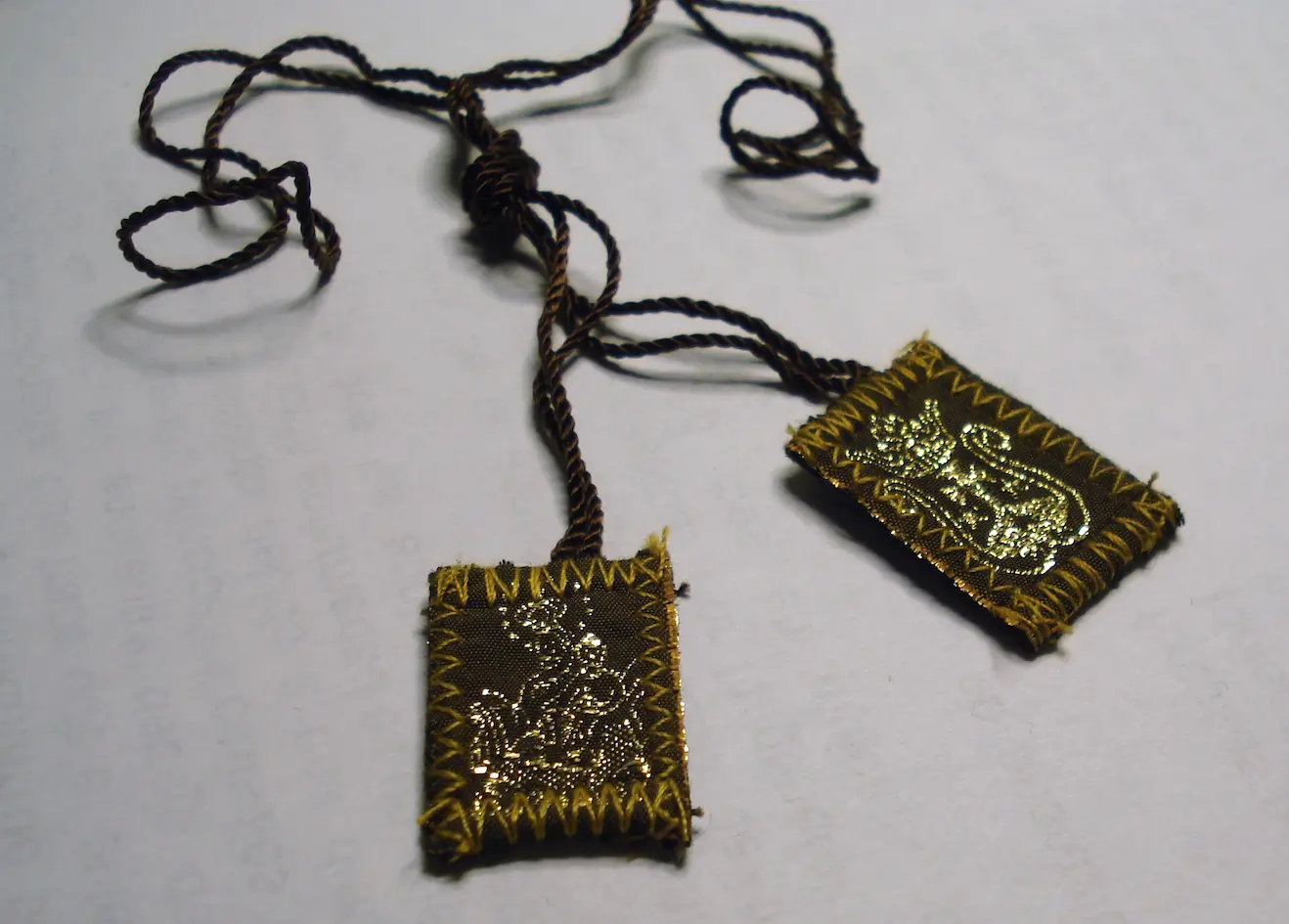
The brown scapular, properly called the Scapular of Our Lady of Mount Carmel, consists of two small rectangular panels of brown wool cloth joined by two cords or bands. It is worn over the shoulders so that one panel rests against the chest and the other against the back, beneath the clothing. One panel traditionally bears an image of Our Lady of Mount Carmel and the other an image of the Sacred Heart of Jesus, though plain brown scapulars are also valid.
The small cloth scapular worn by the laity is a miniature of the full scapular of the Carmelite religious habit, which is a long band of cloth worn over the shoulders the length of the body. By wearing the small version, a lay Catholic shares in the spirituality, the protection, and the spiritual family of the Carmelite Order without entering religious life.
The Meaning of the Brown Scapular
The brown scapular is often called the “Yoke of Christ.” This title reaches back to the Carmelite understanding of the scapular as a sign of taking Christ’s own yoke upon one’s shoulders, recalling the words of Our Lord: “Take my yoke upon you, and learn from me; for I am gentle and lowly in heart, and you will find rest for your souls” (Matthew 11:29). To put on the scapular symbolizes an acceptance of this yoke: it is to strive to offer one’s daily labor and suffering to God, and to live in service and surrender.
At the same time, the brown scapular is a sign of consecration to the Blessed Virgin Mary and of being clothed in her protection, her “mantle.” The wearer entrusts himself to Mary’s intercession and places himself under her care, asking her to obtain for him the grace of final perseverance, the grace of dying in friendship with God.
It is important to hold both meanings together. The scapular is not a charm and not a guarantee of salvation apart from a life of faith. As a sacramental, it disposes the wearer to grace and bears fruit according to the faith and devotion with which it is worn. It is, in the truest sense, a worn prayer.
A Brief History
According to Carmelite tradition, the brown scapular was given to St. Simon Stock, an early leader of the Carmelite Order in England, when the Blessed Virgin Mary appeared to him in the year 1251. Mary presented the scapular as a “badge” of her confraternity and a sign of her protection for the Carmelites and all who would wear it in faith. From the Carmelite Order, the devotion spread throughout the Church and became the model for the many other devotional scapulars that followed.
The brown scapular received repeated encouragement from the Church over the centuries and was associated with the apparitions at Fatima in 1917, where Our Lady appeared as Our Lady of Mount Carmel holding the scapular during the final apparition in October.
The Promises of the Brown Scapular
The brown scapular is associated with a promise of protection traditionally attributed to Our Lady’s words to St. Simon Stock: that whoever dies clothed in the scapular will be preserved from eternal fire. A second promise, known as the Sabbatine Privilege, concerns Mary’s special intercession for the souls of scapular wearers after death.
These promises are among the most beloved and the most misunderstood aspects of the devotion. They are not unconditional guarantees; the Church has always taught that they presuppose a genuine life of faith and cooperation with grace. Because they deserve careful treatment, they are explained in full on a dedicated page.
How to Wear the Brown Scapular
The brown scapular is worn over the shoulders so that one panel of cloth hangs over the chest and the other over the back, beneath the clothing. It is not worn as a necklace or a bracelet; the traditional form of the devotion requires that it rest upon the shoulders in the manner of the religious habit it imitates.
A few rules guide the proper wearing of the brown scapular:
- The scapular must be blessed by a priest or deacon to be a true sacramental. An unblessed scapular is simply cloth and carries none of the spiritual benefits of the devotion.
- The wearer should be enrolled (invested) in the brown scapular at least once, traditionally by a priest. This brief rite receives the person into the spiritual family of the scapular. After this first enrollment, a worn scapular may be replaced with a new one without repeating the rite.
- The scapular is meant to be worn continually, day and night, as a constant sign of consecration. It is made of wool in keeping with the material of the Carmelite habit.
- Many of the faithful pair the wearing of the scapular with a daily prayer or a morning offering, renewing their consecration each day.
Caring for and Replacing a Scapular
A brown scapular that has become worn may be respectfully disposed of, traditionally by burning or burying it, and replaced with a new one. A person who has already been enrolled does not need to be enrolled again, and according to the traditional discipline the replacement does not strictly require a new blessing, since the blessing given at investiture attaches to the devotion rather than to the individual scapular. Many of the faithful nonetheless piously have new scapulars blessed, which is a commendable practice.
For those whose circumstances make wearing the cloth difficult, the Church has permitted a blessed scapular medal to be worn in its place since 1910, though the cloth remains the traditional and preferred form.
Living the Devotion of the Brown Scapular
To wear the brown scapular is to carry a small and humble sign of a great commitment. It is to take up the yoke of Christ each morning, to offer the labors and trials of the day to God, and to walk through life clothed in the protection of His Mother. Like the Rosary, the scapular’s worth lies not in the cloth itself but in the faith and love it expresses and the grace it disposes us to receive.
For those who wish to live the devotion fully, the path is simple: be enrolled by a priest, wear the blessed scapular faithfully, and renew the consecration daily through prayer. In this way the brown scapular becomes what it was always meant to be, not a charm, but a continual act of trust in Christ through the hands of Mary.
Frequently Asked Questions
What is the brown scapular for?
The brown scapular is a sign of consecration to the Blessed Virgin Mary and of sharing in the spirituality of the Carmelite Order. Worn in faith, it is a continual prayer asking Mary’s protection and her intercession for the grace of final perseverance.
Does the brown scapular have to be blessed?
Yes. As a sacramental, the scapular must be blessed by a priest or deacon. An unblessed scapular is simply a piece of cloth. However this applies to the first scapular only. According to the traditional discipline a replacement does not strictly require a new blessing, since the blessing given at investiture attaches to the devotion rather than to the individual scapular.
What is the brown scapular made of?
The brown scapular is traditionally made of brown wool, in keeping with the material of the Carmelite habit. The two panels are joined by cloth bands or cords.
Can you wear the brown scapular all the time, even sleeping and bathing?
Yes. The scapular is meant to be worn continually, day and night. It may be worn while sleeping and bathing, though some choose to remove it briefly when necessary; this does not break the devotion.
Is the brown scapular a necklace?
Though it hangs around the neck on cords and is sometimes called a “brown scapular necklace,” the scapular is not jewelry but a miniature religious habit. It should be worn over the shoulders, with one panel on the chest and one on the back, rather than as an ordinary necklace or pendant.