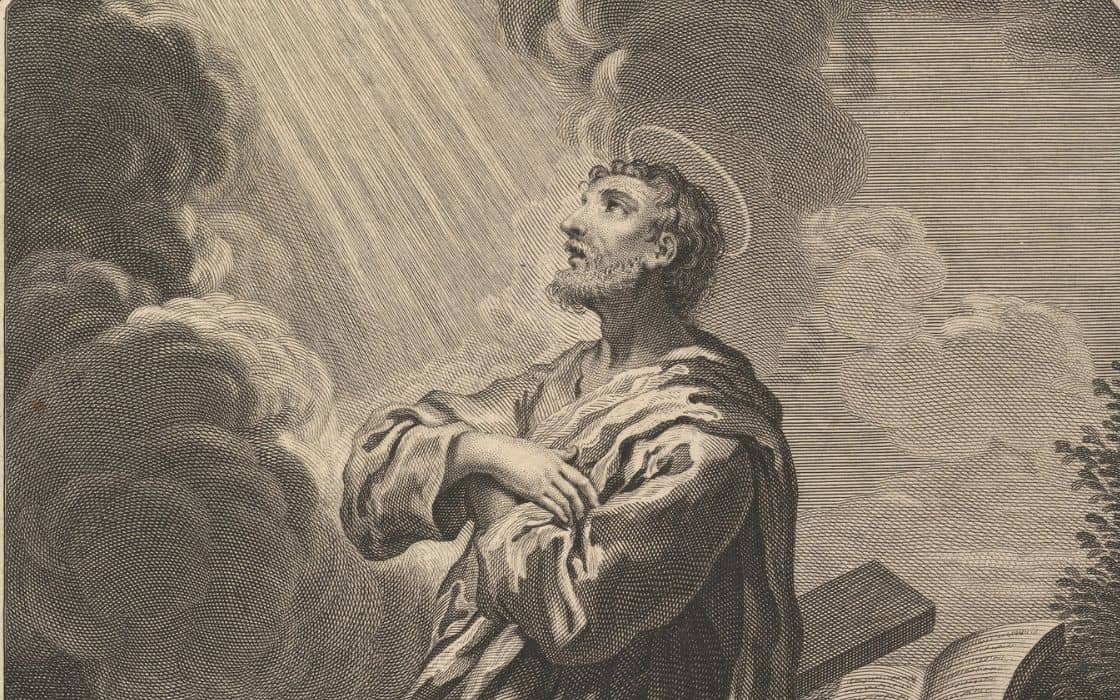
Top image source: Brion, Étienne, after François Boucher. Saint Jude. 1726. Etching and engraving. The Metropolitan Museum of Art, New York.
St. Jude Thaddeus, apostle and cousin of Jesus, is the patron saint of lost causes and desperate situations. Devotion to him grew because of countless answered prayers in seemingly hopeless cases, and, tradition holds, because his name’s similarity to Judas Iscariot left him neglected for centuries. Those who finally turned to him often did so only when every other hope had failed, and he answered. He is one of the most beloved of all patron saints.
St. Jude at a Glance
- Patronage: Lost causes, desperate situations, hospitals
- Feast Day: October 28th
- Symbols: Flame above head, image of Christ (Image of Edessa), club/halberd
- Also Known As: Judas Thaddaeus, Lebbaeus
Did you know that St. Jude was related to Our Lord and one of His twelve apostles? That he wrote an epistle? And that despite great miracles credited to him, he was all but forgotten by the faithful for centuries? Today, however, devotion to St. Jude has returned, and his intercession has been so effective that he is honored in shrines and churches throughout the world. Let’s learn more about this powerful saint and how he can help us today.
Who is St. Jude?
His Devout Family
St. Jude, also called Thaddeus in the list of the apostles, was one of the Twelve. His name was actually Judas, a common name in Bible times. Christians sometimes confuse him with Judas Iscariot, who betrayed Jesus, but he is not that Judas! St. John actually clarifies this in his Gospel narrative of the Last Supper (John 14:22).
He was the brother of James the Less, the first bishop of Jerusalem, and their mother was Mary of Cleophas, who stood with Our Lady at the foot of the cross during Our Lord’s passion. Mary of Cleophas was the Blessed Virgin Mary’s half-sister, making St. Jude a first cousin of Our Lord Jesus. Despite his relation to the Savior, the Gospels contain little about him. Only one short question is attributed to him. This may indicate St. Jude was slow to speak, preferring to learn by observing and listening to the Master.
His Humble Character
We see evidence of St. Jude’s humility in the introduction to his brief epistle. He does not identify himself as a relative of the Lord, or by his own position as apostle, but rather as “the servant of Jesus Christ, and brother of James.” Yet his epistle reveals St. Jude’s zeal for the Faith. It packs a powerful message in just a few words, urging Christians to resist heretics who have “secretly entered in” and to hold fast to the words “spoken before by the apostles.”
St. Jude, along with all the apostles, deserted Christ after He was betrayed. But all of them, except Judas Iscariot, repented and were together with the Blessed Virgin Mary in the Upper Room on Pentecost. Filled with the Holy Spirit, St. Jude became a powerful evangelist in Mesopotamia and later in Persia with St. Simon, where they were both eventually martyred. Tradition tells us St. Jude was patient with his enemies, performed great miracles, and converted thousands to the Faith.
His Years in Persia and Martyrdom
St. Jude spent many years evangelizing and was one of the last apostles to die. In Persia, along with St. Simon, he preached, healed, and rescued many souls from the evils of sorcery. Several prominent magicians in the king’s court repeatedly tried to harm the apostles, but their mischief was turned back against them. Nevertheless, more than once, St. Jude intervened to save the lives of these idolatrous priests in hopes of converting them. Although the Babylonian king and thousands of his people converted to the Faith, the sorcerers never did. Their infernal hatred for St. Jude was relentless, and they would not rest until they had destroyed him.
After many years of missionary work and adding thousands to the Church, St. Jude was called to give his life for his Savior. A murderous mob, incited by his enemies, attacked him, bludgeoned him to death with clubs, and beheaded him. We frequently see the image of St. Jude carrying a club to honor the manner of his martyrdom.
St. Jude is known as the Patron of Hope and Lost Causes for many powerful miracles during his life on earth and especially after his death.
The Patron of Hope and Lost Causes
The King of Edessa
One of St. Jude’s first missions after Pentecost was to visit the King of Edessa in Mesopotamia, in answer to a request the king had made of the Lord during his ministry. The King is believed to have been suffering from leprosy, and his condition was grave. He had heard of Jesus and His healing power and sent a letter to Him requesting that He come to Edessa in Mesopotamia. The Lord returned word to the king, declining his request and explaining that He had been sent to the House of Israel. But He promised that sometime later, He would send one of his disciples, whom we believe to be St. Jude.
It is said that Our Lord sent the king an image of His divine face imprinted on a cloth as a pledge that someone would come to heal him. This cloth is known as the Image of Edessa, and for this reason, we often see St. Jude wearing or holding an image of Christ’s face. After Pentecost, St. Jude made the promised visit to Edessa. As he entered the king’s presence, light was emanating from him. When St. Jude touched the king, he was healed and immediately converted to the Faith. St. Jude remained in Mesopotamia for many years, traveling, preaching, and healing the sick, converting thousands to the faith.
Great miracles marked St. Jude’s ministry, both in Mesopotamia and later in Persia. He brought untold numbers of souls to Christ, freeing them from sin, sickness, and possession. He exhibited power over demons, magicians, and sorcerers, turning every attempt to harm him back to the source from which it came.
Help for Persecuted Christians and Victory for the Faith
After his death, grand miracles continued through St. Jude’s intercession, such as the period of peace for Christians granted by the Roman Emperor Domitian upon hearing the testimonies of St. Jude’s grandsons. Later, in the year 260, the Emperor Valerian, who hated, persecuted, and killed many Christians, was soundly defeated and captured in battle by the smaller army of Shapur I of the Sassanid Persian Empire. The battle was fought on the plains of Edessa, the land that was converted to Christianity by St. Jude. When Valerian’s son heard of his father’s capture, he attributed it to the heavy persecutions he had authorized and promptly rescinded the anti-Christian decrees. Christians attributed this “Little Peace” to the intercession of St. Jude Thaddeus.
Roughly fifty years later, the famous and decisive battle of the Milvian Bridge between Constantine and Maxentius was won by Constantine against all odds, resulting in the Christianization of the Roman Empire. The date of this victory is October 28th, the feast of St. Jude.
Centuries of Obscurity and Return to Devotion
Yet after those early centuries and the significance of St. Jude’s intercession in the life of the nascent Church, devotion to him ironically fell into obscurity. This is believed to be simply because his name was the same as the traitor’s, offensive to the faithful. Because so few called on him, those who did were often the desperate, the ones who had exhausted every other avenue. Their prayers were answered, and his reputation as the saint of hopeless cases was born. In the 16th Century, stirrings in the Church brought St. Jude back to the forefront. Pope Paul III granted a plenary indulgence to those who made a pilgrimage to St. Jude’s tomb on his feast day. Our Lord Himself told St. Bridget of Sweden to call upon “Thaddeus,” who “will always be found willing to help.”
In more recent times, the faithful throughout the world have returned to invoking St. Jude for their hopeless situations, and myriad prayers have been miraculously answered. Because of St. Jude’s readiness to help and heal when called upon, he is again loved and honored in churches and shrines with fervent and loyal devotion.
St. Jude and Hospitals
St. Jude’s patronage of hospitals and the sick is closely tied to one of the most famous answered prayers of the twentieth century. As a struggling young entertainer, Danny Thomas prayed to St. Jude for direction in his life and promised to build a shrine in his honor if his prayers were answered. His career flourished, and he kept his promise by founding St. Jude Children’s Research Hospital in Memphis, Tennessee, in 1962. The hospital treats children with cancer and other catastrophic diseases without charging their families. Today it stands as a living testimony to St. Jude’s intercession in what seemed a hopeless cause.
A Prayer to St. Jude
There are many prayers to St. Jude, from the traditional prayer recited at his shrines around the world to prayers for hope, healing, financial difficulties, and loved ones in need. You can pray all of them on our Prayers to St. Jude page. To pray for nine days leading up to his feast, or at any time of year, pray the St. Jude Novena.
Are you facing a hopeless situation? Have you prayed and feel it’s a lost cause? Has discouragement set in? Consider calling upon St. Jude to intercede and assist you. If there is a shrine nearby, visit him there and request his help. Or pray a novena, and perform some act of kindness in his honor. Encourage others to pray to him with you, increasing their faith and yours. Promise him you will promote further devotion to him in thanksgiving when your prayers are answered, and keep your promise!
If your need feels not just difficult but impossible, you may also wish to pray the Novena for Impossible Requests or the St. Rita Novena, and if anxiety weighs on you, our Catholic Prayers for Anxiety, Worry, and Fear may help.
Learn More About St. Jude
- Pray our complete Prayers to St. Jude.
- Pray the St. Jude Novena, October 19 through 27.
- Listen to our reflection on the Feast of St. Jude.
Frequently Asked Questions about St. Jude
Why is St. Jude the patron saint of lost causes?
St. Jude is the patron of lost causes because his intercession has proved powerful, bringing favorable results when all other prayer attempts have seemingly failed. Tradition also holds that, because his name resembled that of Judas Iscariot, the faithful neglected him for centuries, and those who finally invoked him did so only in desperation. Their answered prayers earned him his title.
Is St. Jude the same as Judas Iscariot?
No. St. Jude Thaddeus and Judas Iscariot were two different apostles who happened to share a common name. Judas Iscariot betrayed Our Lord; St. Jude remained faithful, wrote an epistle in the New Testament, and was martyred for the Faith. St. John’s Gospel makes the distinction explicit (John 14:22).
When is the Feast Day of St. Jude?
St. Jude shares a feast day with St. Simon because they traveled, ministered, and were likely martyred together in Persia. Their feast day is October 28th.
Why is St. Jude associated with hospitals?
St. Jude Children’s Research Hospital was founded by Danny Thomas in thanksgiving for prayers answered through St. Jude’s intercession. Because of the hospital’s work with gravely ill children, St. Jude has become closely associated with hospitals and desperate medical situations.
What images are associated with St. Jude?
St. Jude is usually seen with a flame above his head to symbolize that he was one of the apostles in the upper room filled with the Holy Spirit on Pentecost. He often holds or wears an image of Our Lord’s face because Jesus sent an image of Himself to the King of Edessa as a pledge that He would send a disciple (St. Jude) to heal him. St. Jude also carries a club, which signifies how he was martyred, beaten to death before being beheaded.