Top image source: Boston, CC BY-SA 3.0 https://creativecommons.org/licenses/by-sa/3.0, via Wikimedia Commons
The brown scapular of Our Lady of Mount Carmel is the most beloved and widely worn scapular in the Church, but it is far from the only one. Over the centuries the Church has approved around eighteen small scapulars, each arising from a particular religious order or apparition, each bearing its own color, its own devotion, and its own promises. This guide introduces the principal scapulars beyond the brown and green, explaining where each came from, what it means, and how it is worn, so that the faithful may choose the devotion that speaks most powerfully to them.
The brown scapular and the green scapular each have their own complete guide; here we gather the others: the red, blue, black, and white scapulars, along with a note on the Fivefold Scapular that unites several of them.
What All Scapulars Have in Common
Before turning to the individual scapulars, it helps to recall what unites them. Every devotional scapular is a sacramental: a sacred sign, blessed by the Church, that disposes the wearer to grace and prepares him to receive it through the prayer of the Church and his own faith and devotion. A scapular is never a charm or a guarantee; it bears fruit according to the faith with which it is worn.
Most of the small scapulars share the same simple form, two small panels of wool joined by cords, worn over the shoulders so that one panel rests on the chest and the other on the back. Most also require that the wearer be blessed and enrolled (invested) once by a priest, after which the devotion may be lived by wearing the blessed scapular faithfully. The green scapular is the notable exception, requiring no enrollment.
Scapular Colors and Meanings at a Glance
| Scapular | Devotion | Origin | Enrollment |
| Brown | Our Lady of Mount Carmel; consecration to Mary and final perseverance | Carmelite Order; tradition of St. Simon Stock, 1251 | Enrolled once by a priest |
| Green | Immaculate Heart of Mary; conversion of sinners and a happy death | Sister Justine Bisqueyburu, Daughters of Charity, 1840 | None; blessing only |
| Red | The Passion of Our Lord and the Sacred Hearts of Jesus and Mary | Sister Apolline Andriveau, Daughters of Charity, 1846 | Invested by a priest |
| Blue | The Immaculate Conception; purity | Venerable Ursula Benincasa, Theatine tradition; approved 1671 | Invested by a priest |
| Black | The Seven Sorrows of Mary | Servite Order, thirteenth century | Invested by a priest |
| White | The Most Holy Trinity; prayer for captives | Trinitarian Order, founded 1198 | Invested by a priest |
| St. Michael | St. Michael the Archangel; protection against evil | Archconfraternity of the Scapular of St. Michael | Invested by a priest |
| Fivefold | Combines the brown, blue, black, red, and white in one garment | Redemptorist tradition; cumulative blessing permitted by Leo XIII | One combined investiture |
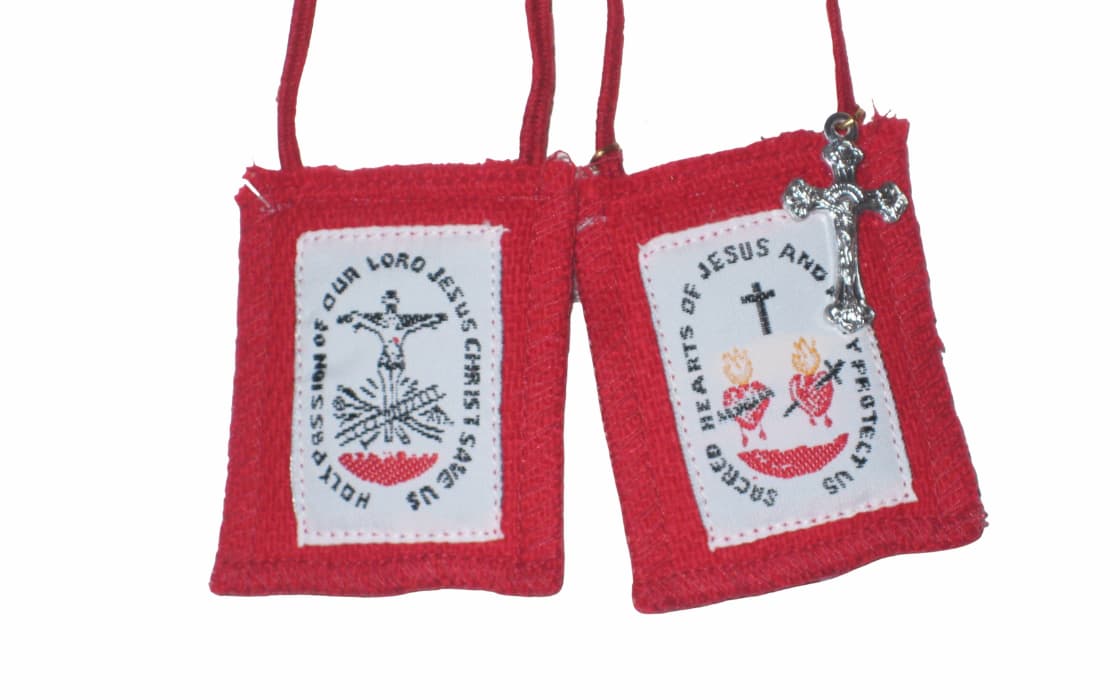
The Red Scapular of the Passion
The Red Scapular, properly the Scapular of the Passion of Our Lord and the Sacred Hearts of Jesus and Mary, was given through apparitions of Our Lord to Sister Apolline Andriveau, a Daughter of Charity of St. Vincent de Paul, at Troyes, France, in 1846, the same order and era that gave the Church the Miraculous Medal and the Green Scapular. In the visions, Our Lord appeared bearing a red scapular showing the Crucifixion with the instruments of His Passion on one side, inscribed “Holy Passion of Our Lord Jesus Christ, save us,” and the Sacred Hearts of Jesus and Mary on the other, inscribed “Sacred Hearts of Jesus and Mary, protect us.”
The devotion is one of meditation on the Passion. Our Lord promised that those who wear the red scapular faithfully and contemplate His Passion would receive a great increase of faith, hope, and charity, especially on Fridays, the day the Church commemorates His suffering. It is made of red wool, and its specific images are essential to it.
The Blue Scapular of the Immaculate Conception
The Blue Scapular, the Scapular of the Immaculate Conception, traces its origin to Venerable Ursula Benincasa, foundress of the Theatine Nuns, who received a vision in which Our Lord promised great graces to her order. She begged that the same graces be extended to the faithful in the world who would honor the Immaculate Conception, observe chastity according to their state in life, and wear a small blue scapular. It bears the image of the Immaculate Conception on one side and the name of Mary on the other, and is made of blue wool.
The devotion honors Mary conceived without sin and is especially fitting for those seeking to grow in purity and to prepare for the feast of the Immaculate Conception on December 8. Pope Clement X approved the blessing and investing of the blue scapular in 1671.
The Black Scapular of the Seven Sorrows of Mary
The Black Scapular, the Scapular of the Seven Sorrows (or Seven Dolors) of Mary, belongs to the Servite Order, the Order of the Servants of Mary, formally established in the thirteenth century. Lay men and women who wished to share in the Servites’ devotion to the sorrows of Our Lady formed a confraternity and wore a black scapular, traditionally bearing an image of Our Lady of Sorrows.
The devotion is one of compassion: entering into the seven sorrows of the Blessed Virgin, uniting one’s own sufferings with hers, and meditating on her share in the Passion of her Son. It is a fitting devotion for those drawn to Our Lady of Sorrows and to the Chaplet of the Seven Sorrows.
The White Scapular of the Most Holy Trinity
The White Scapular of the Most Holy Trinity belongs to the Trinitarian Order, founded by St. John de Matha in the twelfth century for the redemption of Christian captives. Tradition holds that at his first Mass St. John de Matha saw a vision of Christ with two captives, and that when Pope Innocent III approved the order in 1198, an angel appeared clothed in a white garment marked with a cross of red and blue. This became the habit of the Trinitarians and the model of the white scapular.
The scapular is white wool bearing the distinctive red and blue Trinitarian cross. Its devotion is dedication to the Most Holy Trinity and a share in the Trinitarian mission of liberation, praying for those held captive by sin or suffering. Those who wear it are received into the Confraternity of the Most Blessed Trinity.
The Scapular of St. Michael
A further scapular worth noting is the Scapular of St. Michael the Archangel, distinctive in form: it is traditionally shaped like a small shield and made of blue and black wool, bearing an image of St. Michael triumphing over Satan. It is connected to the Archconfraternity of the Scapular of St. Michael and is worn as a sign of devotion to the great defender of the Church and protector against evil.
The Fivefold Scapular
For those drawn to several of these devotions at once, the Church permits the Fivefold Scapular (also called the Redemptorist Scapular), which unites five scapulars in a single garment: the brown scapular of the Carmelites, the blue scapular of the Immaculate Conception, the black scapular of the Servites, the red scapular of the Passion, and the white scapular of the Most Holy Trinity.
Originally the faculty to bless and invest these scapulars cumulatively was granted to the Redemptorist Fathers, but Pope Leo XIII later permitted the five to be blessed and enrolled together, and the faculty was eventually extended so that any priest may invest the Fivefold Scapular. It allows the wearer to share in the spiritual benefits of all five devotions through a single blessed scapular.
A word of counsel from the spiritual tradition is fitting here: it is generally better to embrace a few devotions and live them deeply than to multiply them. The Fivefold Scapular is a worthy option for those genuinely drawn to it, but the faithful should choose the devotion that truly moves the heart rather than collecting scapulars for their own sake.
How to Choose and Wear a Scapular
Choosing a scapular is a matter of devotion, not accumulation. Each scapular expresses a particular grace: the brown scapular, consecration to Our Lady of Mount Carmel and the grace of final perseverance; the green, the conversion of sinners and a holy death; the red, meditation on the Passion; the blue, honor to the Immaculate Conception and growth in purity; the black, compassion for the Sorrows of Mary; the white, dedication to the Most Holy Trinity. Pray about which devotion draws you, and take up that one with a whole heart.
To wear any of these scapulars, have it blessed and, where required, be enrolled by a priest. Then wear the blessed scapular faithfully over the shoulders, and live the devotion it expresses through prayer and a good Christian life. A worn scapular may be replaced with a new one without repeating the enrollment.
Frequently Asked Questions
What do the different scapular colors mean?
Each color belongs to a particular devotion: brown for Our Lady of Mount Carmel, green for the conversion of sinners and the Immaculate Heart, red for the Passion of Christ, blue for the Immaculate Conception, black for the Seven Sorrows of Mary, and white for the Most Holy Trinity.
Can you wear more than one scapular at a time?
Yes. A person may be enrolled in and wear several scapulars. The Fivefold Scapular exists precisely to combine five devotions in one garment. Still, it is often better to live one or two devotions deeply than to wear many.
What is the Fivefold Scapular?
The Fivefold Scapular, also called the Redemptorist Scapular, unites the brown, blue, black, red, and white scapulars in a single garment, allowing the wearer to share in all five devotions. Any priest may now bless and invest it.
Do all scapulars require enrollment?
Most of the small scapulars require a one-time enrollment (investiture) by a priest, along with the blessing. The green scapular is the main exception, requiring only a blessing and no enrollment.